Read Part 1.
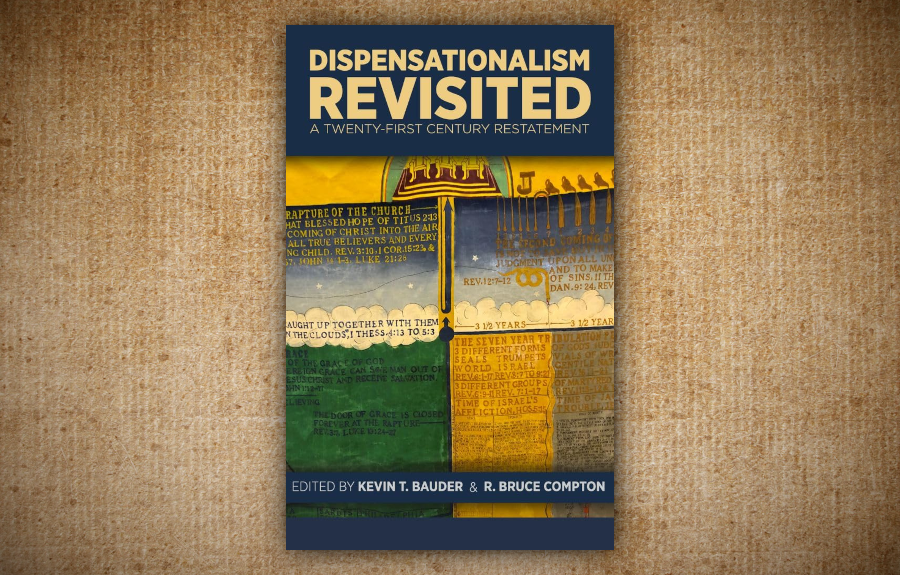
After Beacham’s excellent offering we get one by Kevin Bauder. Bauder is one of the best representatives of Dispensationalism, and any contribution by him will be eminently worthwhile. He writes on Israel and the Church and his chapter is welcome because of the way Bauder tackles the subject. First he addresses the question of just what is meant by “a people of God” (72-79). This is perhaps a little long-winded but at the same time the delineation is most useful in view of the fact that God says that He will have all nations worship Him (78-79).
From there attention is turned to Israel’s mediatorial role (81-82) through whom the other nations will become peoples of God (83), with Israel entering into her promised blessings. Then the Church as Christ’s body through purely spiritual union with Christ (84). The author then illustrates this from John 10:16 (85-86). The olive tree metaphor of Romans 11 is briefly treated, and I appreciated the clear way Bauder distinguishes the root of the tree from its branches (92), something that is too often missed. The best part of the essay in my opinion is Bauder’s treatment of inward versus outward circumcision (95-99). He pulls many threads together in his discussion which the Bible student will appreciate. The whole piece is sure-footed and well-written.
Next comes William Barrick on the covenants of the Bible. Barrick identifies six divine covenants made with Israel: Abrahamic, Mosaic, Deuteronomic, Priestly, Davidic, and New (103). These are briefly surveyed (106-110). The New covenant is given more attention than the others, and I was pleased to read it being described as the covenant that delivers forgiveness of sins (108).
Barrick then deals with the dispensations (110-115). He believes there are eight of them (112), including Eternity but excluding (for whatever reason) the Tribulation! Though the survey is adequate, I was not convinced that the changes in diet reveal dispensational change (110-111). Neither was I impressed with the attempt to track the relationship of the dispensations with the covenants. But he rightly stresses that dispensational progress does not effect salvation by grace through faith (111), and he is correct to say that “Dispensationalism is not a hermeneutic” (116). I disagree that the biblical covenants do not furnish a hermeneutic. I argue that due to their deliberate wording and prescriptive nature they are important hermeneutical signposts.
Bruce Compton’s look at the Kingdom of God/Heaven is valuable. He believes the expression always refers to the future Kingdom (136). He does not dodge potential problems for this interpretation, dealing with the “at hand” and “within” passages well in a few pages. Then (127-132) he turns to the Parables of the Kingdom in Matthew 13. Compton’s reasoning is good, but unfortunately he neglects the crucial phrase “the kingdom of heaven is like” which only appears in Matthew. He does not demonstrate how good and evil can exist side by side in a process (e.g., wheat and tares; leavening; sorting) which ends with the righteous only entering the future Kingdom (Matt. 13:41-43). While I do not think Christ is reigning now from Heaven I think Dispensationalists must carefully engage the meaning of Jesus’ when He says “the kingdom of heaven is like.”
After this comes the last written work of Larry Pettegrew who passed on to his reward earlier this year. It is an article about the way the Church Fathers viewed Israel and is very informative. His chapter reaffirms the fact that up until the middle of the third century many held to premillennial or chiliast eschatology. However, Pettegrew believes that the reason they were not pretribulational was because they accepted the teaching that Israel had forsaken God or had been forsaken by Him. Hence, they had no reason for a removal of the Church before the second advent. I feel this essay should have been placed either up front or at the back of the book. It doesn’t fit where it is and disturbs the flow of the book up until that point.
Chapter 7 (although annoyingly the chapters aren’t numbered) is by Andrew Hudson on the use of the OT in the NT in Acts and its transitional character. Although there were some good things in the chapter, especially in its second half, I think the essay tries to do too much and doesn’t end up doing anything with any real success. The middle section where Hudson runs through the argument of Acts is pretty basic and clogs up the essay (175-179). I did like the overview of interpretations for Peter’s use of Joel 2 in Acts 2 (185-188). Like I said, the latter half of the piece is better than the first.

Discussion
NewAdding this to my reading…
Adding this to my reading list. Thanks for the review Paul!