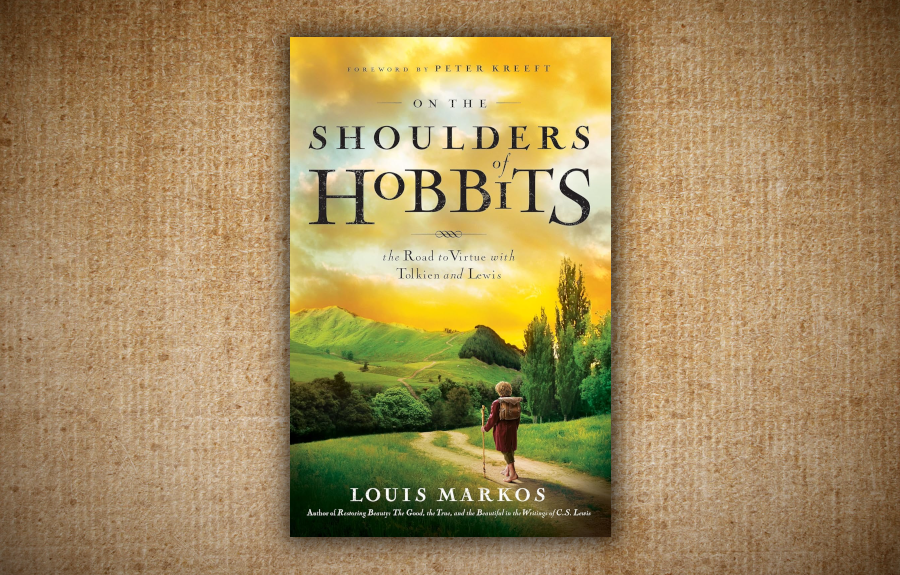
On the Shoulders of Hobbits: the Road to Virtue with Tolkien and Lewis,* by Louis Markos, Chicago: Moody Publishers, 2012, paperback, 234 pages.
When I came across this book at a bookstore I was weighing its purchase against another, more “academic” work that I had in my hand. Just a few years ago I’m ashamed to say I would have put this book down without going to the trouble of contemplating which of the two was the wiser choice. If I had been so hasty I should not have the opportunity to recommend this great little book to you. The author, Louis Markos, teaches English Literature and Classics at Houston Baptist University. He is one of the best Christian communicators around, and the subject of this book is a perfect foil for him. He has taught an intriguing class on C.S. Lewis for ‘The Great Courses’, and his background in classic prose and poetry places him close to Lewis and J.R.R. Tolkien as a kindred spirit.
In talking about hobbits and such Markos is not jumping on a bandwagon.
After an introduction about the true identification of the virtues and the centrality of stories, Markos starts off with a description of how meaning in life is illustrated in sagas or “road” journeys (Part One). In the second chapter he adds that everyone who takes this “Road” has to believe in the journey; that it is worth the taking, and that there is a nobility and a significance in the journey. Add to this the call of God upon His creatures to take “the Road” and you begin to see the attraction of this motif for Tolkien and Lewis among many others. In contrast to the aimlessness of much contemporary thought, life becomes a broad canvass upon which character lessons are drawn. The author brings this out in this excerpt from chapter 3:
As odd as it may seem, one of the greatest obstacles that the members of the Fellowship [in LOTR], or any pilgrim for that matter, must face, is the temptation to cease believing in the Road – to embrace a postmodern, existential nihilism that says that there is neither beginning nor end, that we are all adrift in a world without Purpose, Direction, or Call. In short, that there really is no Road, or, if there is, that it leads nowhere. (49)
This integral meaning extends even to death. Chapter 4 brings out the vital truth that death is not meaningless, and that on the contrary, death might be considered as crucially meaningful. Leaving aside the important truth that death is a punishment (Gen. 3), Markos points out that both writers explored the notion that death is not a realm of darkness, but is the access to the realm of light; the true life.
Part Two discusses the Classical Virtues. These chapters (chs. 4 to 8) each discuss one of these virtues. Let me select one small quote from each chapter to give a flavor of the treatment:
Only those who possess fortitude can bear to have their desires mortified for a higher cause; only the truly courageous can endure the loss (permanent or temporary) of those things that they consider their right and their due.(67)
[Faramir] …never loses his focus, never falters, never allows excessive fear or passion to turn him from the path. (74)
[T]rue wisdom is directly linked too true reality, while folly represents a shrinking and shriveling of both wisdom and reality. (88)
It is this greater sense of order and preservation, of consummation and fulfillment, that is missing from our modern understanding of justice. (98)
Part three of the book turns to the Theological Virtues of Faith, Hope and Love; but Markos begins by suggesting another; that of Friendship (chapter 9). Although it cannot be stated imperatively that one must have friends in the same way that one should have the basic virtues, this chapter helps Markos in his contrast of Christian virtue with worldly values. These chapters build on and maintain the tenor of the whole book. The reader is led to ponder how these biblical values support the purposeful life. The world is a bad place, but these virtues hold our heads up. The world is a bad place, but these virtues hold our heads up. Markos states:
Like the Bible, like The Lord of the Rings, The Lion, the Witch and the Wardrobe has a Happy Ending, but it is one that is suffered and fought for. (130)
In the final part the matter of Evil is taken up in four chapters. There is no space to say much about these chapters, but I particularly appreciated the treatment of the “Byronic Hero” in chapter 13. Markos, using Gollum to illustrate, shows how the whole idea of the world’s romantic anti-hero is in reality a repulsive caricature of a true hero.
The conclusion picks up on what was said in the introduction. It is titled “In Defense of Stories” and it briefly declares that this age needs the kind of stories which will encourage us to follow the heroes of Tolkien and Lewis on “the Road”—and to learn virtue.
The author has included two fine Bibliographical Essays: one on Tolkien and Middle-Earth, and one on Lewis and Narnia to close the book. He is a writer in the old style. One who can show us the structure of inner reality in a world that requires of us lives of true virtue.
I highly recommend this book.
* Affiliate link. Purchases help fund Sharper Iron.