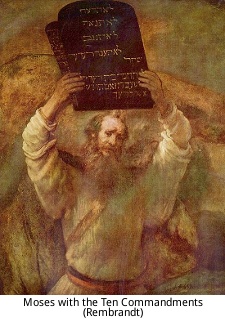
 One of our young people and his friend from another church interviewed a number of pastors in the Kokomo (IN) area. To their surprise, a number of them could not recite the Ten Commandments.
Another one of our young people participated in an after-school Christian ministry where the leader asked if anyone could recite the Ten Commandments. She was the only one who could do so (the leader was surprised, because on other occasions, no one was able to perform that feat). You would think the leader would have changed his lesson plan and taught the kids the commandments then and there (I wonder if he knew them), but his question was merely a jumping point for a lesson about the loss of absolute truth.
We live in a day and age where speakers complain about believers not knowing the basic facts, yet these leaders do nothing to remedy the problem. Complaining about the problem, or revealing it, is not enough: we should, instead, fix the problem. And we should not move on until we have done so.
In the past, I’ve taught the Ten Commandments and Persons of the Trinity during our morning service, conducted a combined Sunday school for grades 1-8 to teach these basics and more, and offered similar material during our Sunday evening service. I have taught much of this material during AWANA or, in recent years, to our summer youth group.
As I was studying 2 Peter (1:12-13) in preparation for one of my sermons, I realized that I had not properly “reinforced” these teachings in recent years. Peter wrote:
Therefore, I will always be ready to remind you of these things, even though you already know them, and have been established in the truth which is present with you. I consider it right, as long as I am in this earthly dwelling, to stir you up by way of reminder.
All Christians need to know and review the basic “facts.” Most of us agree that, by and large, learning concepts is better than mere memorization of information. But not always. Rote memory has gotten a bum wrap: Learning by rote is an excellent way to lay a foundation—especially if you contemplate what you have learned!
I do not want to place the bar too high; instead, I will list what I consider the bare essentials for every Christian to know by rote—basic Christian facts that correspond to learning multiplication tables in math. You might use this information as a list for your own personal achievement, and for instructing your children at home, teaching Sunday school or other classes for children, teens, and yes—adults!
The temptation is to get too deep in analyzing these very important subjects. A superficial rote memorization, though, lays a foundation that can be expanded upon later. Detail-constrained people and the TMI crowd are not the best at teaching these basics!
1. The order of the books of the Bible
Like learning the alphabet before reading, knowing the order of the books of the Bible is foundational to deep Bible study. If you are fortunate enough to have children who have been taught the New Testament and the Old Testament songs, you have an “easy way” to learn the arrangement. Breaking the task into manageable “chunks” is helpful.
Let’s begin with the New Testament. You want to be able to think through the order, so here is a list you might use.
New Testament
- The Historical Books (Matthew-Acts)
- Paul’s Epistles (Romans-Philemon)
- Hebrews
- General Epistles (James-Jude)
- Revelation (Remember, it is not Revelations.)
The list of Paul’s epistles can be the most difficult. Remember, all the “T’s” are together (1 & 2 Thessalonians, 1 & 2 Timothy, Titus); an acrostic for Galatians, Ephesians, Philippians and Colossians is “Gentiles Eat Pork Chops.”
Learn each section before moving on to the next. Always review from the beginning. (“Matthew, Mark….”)
Old Testament
We again have some useful divisions
- The Torah (Genesis-Deuteronomy)
- The Historical Books (Joshua-Esther)
- The Poetical Books (Job-Song of Solomon)
- The Major Prophets (Isaiah-Daniel; note that Lamentations is an appendix to the book of Jeremiah.)
- The Twelve Minor Prophets (Hosea-Malachi)
You can create an acrostic for the twelve Minor Prophets, or you might compromise and look them up in the index if you cannot seem to conquer this challenge. If you know the order of the Old Testament books except for the Minor Prophets, you can get by. Here is an acrostic I use:
Howard Johnson Ate Olives (Hosea, Joel, Amos, Obadiah)
January May Need Heat (Jonah, Micah, Nahum, Habakkuk)
Zoos Have Zebra Mammals (Zephaniah, Haggai, Zechariah, Malachi).
The book most people cannot locate is Nahum. Odds are if you can locate Nahum without consulting an index, you know your Bible order!
2. The Ten Commandments
These are found in Exodus 20, but they are not numbered. I reduce them down to bare bones paraphrases for easy memory. I am more concerned that people still know their commandments at age seventy-three than I am about perfection of wording at age twelve. The secret is to think through them in three sections:
Four commands relating to God:
- No other gods
- No images
- Do not misuse God’s name.
- Remember the Sabbath Day.
Then the authority we recognize first in life, our parents:
- Honor your parents
Then we think of five sins, from worst to least:
- Do not murder.
- Do not commit adultery.
- Do not steal.
- Do not lie.
- Do not covet.
Thinking through the commandments really helps. When explaining meanings to children, they will often ask about adultery. A kid-friendly way to explain this is, “If you are married, do not look for anybody else.” With coveting, I’ll explain it is wanting something too much—so much that you make yourself unhappy or you are willing to do something wrong to get it.
3. The Three Points of the Gospel
These are derived from I Corinthians 15:1-6. When memorizing this, I encourage folks to emphasize, “for our sins.” The fact that Christ died is history, but the fact that He died for our sins is theology and salvation!
- Christ died for our sins.
- He was buried.
- He rose again on the third day.
4. The Three Points of the Great Commission
These are derived from Matthew 28:19-20. I summarize “teaching all things” as “discipleship.” The points, then, are these:
- Evangelism
- Baptism
- Discipleship
5. The storyline of the major events in the entire Bible
These include Creation, the Fall, the Flood, Abraham, Isaac, Jacob, Moses, Judges, King David, Solomon, divided kingdom, Babylonian Captivity, return to Jerusalem under Ezra, birth of John the Baptist, life of Jesus, Pentecost, inclusion of the Gentiles. The best way to get this is by reading through the Bible. Attending Sunday school and attentiveness during sermons over the years helps to refresh these, too. Children’s story Bibles help rehearse the main narratives.
6. Persons Who make up the one Triune God
- Father
- Son
- Holy Spirit
Please do not teach “God, Jesus, and Holy Spirit” as the Trinity. This is not quite accurate. By calling only the Father “God,” you are implying that the Son and Spirit are something less than God. By naming Jesus as part of the Trinity, you are including His human nature, which had a beginning (remember, God has been triune eternally). God the Son has always existed, but the human nature of Jesus began in Mary’s womb.
7. The importance of the nation of Israel
This is a topic of controversy. Although all Christians would acknowledge the importance of Israel in the past (the nation producing the Messiah, the Bible, and the Apostles), most of Christendom believes that God is done with Israel forever. We disagree and assert that this is an important issue.
At present the existence of the nation of Israel is an indication of God’s faithfulness and thus an evidence of the truth of the Bible. The only thing that makes sense of Israel’s existence is God’s end-time plans for Israel (her future conversion and exaltation during the Kingdom Age). See Romans 11.
(Note: I recognize that many SI readers do not believe in an exalted Israel in the future. Please feel free to nix this one if your views differ from mine.)
8. The Solas
These are the five Biblical “alones” reclaimed during the Reformation. I prefer to condense them to two statements:
Scripture Alone. We are not saying that the Bible is the only authority, but rather, the Bible is the only infallible and thus the final authority. (Other authorities—like governments, parents, or church leaders—are fallible but to generally be respected; clear Scripture, however, can trump these authorities.)
Salvation by God’s grace alone through Christ alone by faith alone to God’s glory alone.
9. Minimal verses every Christians should understand and have memorized
John 3:16, I John 1:9 and the “Romans Road” verses (Romans 3:10, 3:23, 5:8, 6:23 and 10:9). It might be good to also include Ephesians 2:8-9.
John 3:16 is a simple salvation verse. I John 1:9 is a verse every Christian needs to know—confessing our sins to God and dealing with guilt is an important part of a godly walk. The Romans Road verses can be used for personal assurance but are especially well suited to lead someone to faith in Christ. The Ephesians verses are, in a sense, a clarification of what Romans 6:23 means—salvation is a gift. A gift really is a gift!
We are never done learning as Christians, so please do not stop with the above! This is meant to be a starting point, not an ending one. Just as we learn our multiplication tables and then move on to division, fractions, and decimals, so the basic Christian “facts” are a foundation upon which to build.
For SI readers, an addendum: Those of us in leadership (whether lay leaders or clergy) must repeatedly re-lay this foundation. We should never assume our folks have this foundation. I would challenge skeptics (optimists who believe their people know all these facts) to give an anonymous test to their Sunday school class, youth group—or attenders at a morning service. But be prepared for disappointment! I believe the overwhelming majority of Christians do not know their basic Christian facts by rote. They might pick up the Ten Commandments if given a multiple-choice quiz, but can they list them? Not many can.
Ed Vasicek was raised as a Roman Catholic in in Cicero, Illinois. During his senior year in high school (in 1974), Cicero Bible Church reached out to him, and he received Jesus Christ as his Savior by faith alone. Ed later felt a call to ministry and enrolled at Moody Bible Institute (B.A., Pastoral Studies/Greek). After graduating, he served as pastor of Victory Bible Church of Chicago (a branch work of Cicero Bible Church) and married Marylu Troppito. In 1983, the couple moved to Kokomo where Ed began pastoring Highland Park Church, where he still serves. Ed and Marylu have two adult children, Hannah and Luke. Ed loves to write. He has written over 500 weekly columns for the opinion page of the Kokomo Tribune, published articles in Pulpit Helps magazine, and populated his church’s website with an endless barrage of papers. You can access them at www.highlandpc.com.

Discussion
NewGreat list
On point 3, I think the passage presents two, not three, points in the gospel:
1. Christ died for our sins, according to the Scripture
and was buried;
2. He rose again the third day, according to the Scripture
and was seen.
The “buried” and “seen” observations are simply confirmations of the “died” and “rose” points, which are highlighted by the phrase you noted, “according to the Scripture.”
Second, on point 5, I use a little chronological trick to help me place everything in order. Key OT actors appear every 500 years: Noah, 2500 BC (this is the most controversial date); Abraham, 2000; Moses, 1500; David, 1000; Ezra, 500.
This pattern makes it fairly easy to place everything else into a confined slot. For example, the Egyptian period is between Abraham and Moses, so it’s around 1750; the judges are between Moses and David, so they’re around 1250; Elijah is between David and Ezra, so he’s around 750. That helps me remember order for pretty much everything in the OT, and order has a lot to do with cause and effect, which has a lot to do with harvesting key principles from history. My students find it helpful as well.
BTW, the AD dates do the same thing with major theologians: Paul, 0; Augustine, 500; Thomas Aquinas, 1000 (or so); Calvin, 1500; Barth, 2000. (Please don’t take Barth’s inclusion as an endorsement; but he is a major theologian.)
Thanks for the thought-provoking piece.
Dan Olinger, PhD Chair, Div of Bible, BJU
NewGreat Job, Ed
Dr. Olinger, I will henceforth refer to church history as the Paul-Augustine-Aquinas-Calvin-Barth continuum. Poor Luther and Schleiermacher!
My Blog: http://dearreaderblog.com
Cor meum tibi offero Domine prompte et sincere. ~ John Calvin
Newquiz
Dr.O, I’ve found the 500 year markers helpful as well. Can’t remember where I saw them first, maybe Talk Thru the Bible by Wilkinson and Boa.
Anyway, thanks, Ed. I think we might have a quiz at our church.
Views expressed are always my own and not my employer's, my church's, my family's, my neighbors', or my pets'. The house plants have authorized me to speak for them, however, and they always agree with me.
Newjust a thought...
Just one thought however… while I acknowledge that 1 Cor. 15 presents the gospel in somewhat of a “nutshell,” I think that we should be careful not to think (or teach) that this is all that the gospel consists of or entails. Paul was assuming a lot that he fills in elsewhere in his letters. The wages of sin, The deity of Christ, his sinless life, the necessary response of repentance and faith, etc. are all part of the gospel as well. So while I see the value to some degree of using 1 Cor. 15 as a teaching device about some of the basics of the gospel, we must be careful IMO that we don’t reduce the gospel to those three (or two) facts.
I imagine you wouldn’t disagree as most of the other things are more like mental hooks on which much else hangs, I just am a bit cautious (perhaps over-cautious) because I have too often heard 1 Cor. 15 presented as the sum total of the gospel, rather than the center of the gospel, or basics of the gospel, or some such thing.
New"gospel"
Of course, many have pointed out that the points Paul lists in 1Cor.15 do presuppose other points like why He died, and who He is. So these ideas are certainly not excluded.
Romans 2:16, for example, includes the judgement.
I know I’ve seen a passage or two where “gospel” seems to include the entire Christian way of life, though I can’t seem to find an example at the moment. Usually, it seems to be the message in 1Cor.15 along with points that are indispensable to it.
Views expressed are always my own and not my employer's, my church's, my family's, my neighbors', or my pets'. The house plants have authorized me to speak for them, however, and they always agree with me.
NewThanks, everyone
Charlie said:You are right, Charlie. We are seeing the same problem in the education field, too. We can no longer expect people to memorize at home: we have to teach ‘em when we have ‘em.
Aaron said: The problem in this area is TMI, Too much information. Walk Thru the Bible seminars can be great reinforcers for those who have read through the Bible at least a few times, but I wonder how many people really retain all that info?
DOlinger wrote:I admit there is a parallelism there, so you could do it that way. But more is not always better, especially when getting the basic facts down. Still for memory, I think the 3 points are easier and briefer. Kind of the same philosophy I expressed about the commandments:Ryan said:Well, this is about getting down the Basic Facts. I believe Paul himself makes it clear that the I Cor. 15 passage are the BASIC foundation, but not all there is. Note I Cor. 15:3Aaron said:I think we can all probably agree with Aaron’s summary on this idea.
Thanks for the great discussion, everyone! And if any of you take quizzes in your Sunday School classes, church services, or fellowship/study groups, please share the results!
"The Midrash Detective"
NewWithout appearing to fail to
I do realize it is handy and helpful, maybe, to not have to use a table of context but simply memorizing it as an essential instrument for further enlightenment is something I would like explained. It occurs to me that as a matter of practical consequence the student of the Scriptures, due to their familiarity, would eventually have the locations down rather rapidly as it is.
But don’t misunderstand me, I am not dissuading anyone’s memorization of the order of the books, certainly not, I am merely interested in reconciling how such a memorization of a table of contents is “foundational to deep Bible study”. And if there is some response my hope is additional inquiries are welcomed.
My blog: http://thepedestrianchristian.blogspot.com/
Newone of those typo's ...
Thanks,
Ryan
Newbooks of the Bible
BTW, Edd, I appreciate your emphasis on rote facts, our education system seems to have downplayed memorization in favor of “discussion.” While discussion and critical thinking are necessary, how can one think critically if there is nothing to think about. Facts are important.
www.dgministry.com www.christianjoe.graceutah.com
NewMy Thinking on why the order is important
Being “quick on the draw” is an important skill because most people learn better if they both see AND hear. This would fall under the category of “practical skills.”
It can be hard for the theologically minded and the detail-oriented to get down to basic skills. We are talking about starting points, not ending ones. We are talking about primer readers, not Shakespeare.
"The Midrash Detective"
NewRyan wrote: Quote: "I do
My blog: http://thepedestrianchristian.blogspot.com/
NewEd Vasicek wrote: Quote: I
I find the unusual assertion that memorizing the table of contents “foundational to deep Bible study” very untenable here. I do agree that the friendliness of such a memorization to the matter of our convenience is real but unlike learning history, languages, or elementary doctrines which enhance our capacity to grasp content, simply being able to turn somewhere about 20 seconds before another person who uses a table of contents seems to render dubious the proposition that it is a foundational necessity for deep Bible study.
And I do agree that anyone suggesting that learning the table of contents is not valuable, is wrong. I just would not assign its value as a foundational necessity to deep Bible study. I believe one can have deep Bible study and not have the table of contents memorized. However, I do not wish to detract from the contribution of the rest of the article and have made my point which seems obvious enough to my own satisfaction so I don’t feel the need to further it unless you have other questions or someone has a further challenge to my observation. Thanks.
My blog: http://thepedestrianchristian.blogspot.com/
NewOn an aside, I learned the
Thorough students of the Bible do know the books of the Bible in order, whether one wants to argue that it is essential for study or not. Based on what I acknowledge is merely anecdotal evidence, I would say that those who do not know where to find a certain book in their Bibles usually are not studying the Bible for themselves. Helping someone to learn the books of the Bible gives them a tool to become better Bible students; at the very least, they will not be hindered (or frustrated) by the difficulty of finding the right passage at the right time. Granted, a newly saved believer may rely entirely on his table of contents; but if he is serious about growing and learning (and studying the Bible), he will soon have their order memorized.
Given our experience with discipleship and ministry, I agree with Ed. Thanks for a great article and some good ideas, Ed!
NewI still remember
- The Books of the Bible
- The Romans Road
- The 12 Apostles (52 MAB ST)
- The 12 Tribes of Israel
- The 10 Commandments
In addition, we learned to draw a free hand map of Palestine to the tune of O Tannebaum. (first the line of coast we make, then Merom, a marshy lake, then the Sea of Galilee, directly east of Mount Carmel …..) and locate major cities.
We also learned a hymn each week (partly because they weren’t enough hymn books for everyone).
The Sunday School curriculum drawn up by the pastor took us through the Bible in about 5 years.
While I can’t remember where I put my car keys, I still remember these things.
And thanks to Dan Olinger, the “500 year” list has been added.
"Some things are of that nature as to make one's fancy chuckle, while his heart doth ache." John Bunyan
NewFacts as framework
I’m often amazed that people who’ve faithfully attended church for 10-20-30+ years don’t have many of the basics Bro. Ed lists available for recall. But we do have to be careful not to mistake recitation for understanding- some of the kids who can win all the sword drills and Bible quiz games can’t tell you the meaning of the Lord’s Supper or believer’s baptism.
Scenescape Media
NewQuote: Memorization of key
This is a critical subject, and I appreciate seeing it laid out so practically.
Welcome to the SI posting world, Dr. O.!
NewThis is a great mystery
And we had to learn it PERFECTLY — not just “close is good enough ‘cuz its the Bible.” :)
This is a great mystery: the very people who you might think would be committed to the Bible above all else are instead plagued with Biblical illiteracy. In many of our Baptist churches, Bible knowledge is looked at as something almost superfluous, as if it is only for the “super-saints” or “super-curious.” Often people are skeptical even of pastors who might “know too much,” and seem more comfortable with those who “preach on their level,” and focus on application rather than exposition. I suppose that the pastors who didn’t know the Ten Commandments might fit in that category.
In my experience, the KJV-only mentality, especially among those who hold the position but cannot defend it with any factual basis, often ties to Biblical illeteracy and a Christianity that is built solely on emotionalism.
Church Ministries Representative, serving in the Midwest, for The Friends of Israel Gospel Ministry
NewDon't get me going!
As to Christian Day schools, I’ve seen everything from Hermeneutics, Bible Doctrines, OT and NT Survey through re-cycled Sunday School curricula to Bible as an elective.
Bible facts like those mentioned are essential as is basic Bible doctrine and those Bible facts are the “grammar” that form the foundation for further learning. I still use the chapter content of the NT I had to memorize.
My conclusion is that the best place to do this is at home.
"Some things are of that nature as to make one's fancy chuckle, while his heart doth ache." John Bunyan
NewMany places
I learned them as a kid in “Junior Church.” We went over them and over them until we could quote them very quickly. Then we did Bible Drills for years after that.
By itself, it’s perhaps not a huge thing, but for us it was part of a culture of Bible literacy. Every service at that church (and the ones we attended after that one as well) was an event in which we heard the sound of dozens (or hundreds, depending on the church) of people turning to multiple passages of Scripture as we examined the word together. It still sounds like a kind of music to me.
Views expressed are always my own and not my employer's, my church's, my family's, my neighbors', or my pets'. The house plants have authorized me to speak for them, however, and they always agree with me.
NewQuote: My conclusion is that
NewLet's make it happen
Some information, like the names of the Apostles or the 12 tribes of Israel are probably not that crucial, IMO. The two Great Commandments, however, might be a good addition, as one brother here at the church suggested.
Paul Scharf said:I think we should learn from this. There is no reason why we should not set up a mechanism somewhere in our church programs to make this happen. I am doing this on Sunday morning as my sermon “intro.” I did the same thing about 1999, so, as I mentioned, it is time to repeat. Three minutes a week with the adults is a good starting point. I almost think that we pastors should guarantee that our people are given a significant opportunity to learn these things by rote while in church or Sunday School. The days of people studying at home are tragically mostly over.
"The Midrash Detective"
NewQuote: As I have stated on SI
NewThanks Ann
Church Ministries Representative, serving in the Midwest, for The Friends of Israel Gospel Ministry
NewVariety
… alas, I know a few Baptists who could do no better.I think that’s well put, Ed.
Views expressed are always my own and not my employer's, my church's, my family's, my neighbors', or my pets'. The house plants have authorized me to speak for them, however, and they always agree with me.
NewExceptions, some but no many...
The same is true with an accurate listing of the Names of the Persons of the Trinity, as simple as that is. So let me issue a challenge to one and all: Test kids in your family and church (Sunday school class, study, etc.), and share the statistics with us. As them to produce — not merely identify — these two things.
Incidentally, a number of pastors who could not list the 10 Commandments were evangelical, including a Baptist minister.
"The Midrash Detective"
NewRegarding Lutherans
For the most part, the only Lutherans who have schools are the conservaties (WELS, ELS, LCMS, CLC, etc.).
Within a Lutheran congregation, of course, there is still a big drop-off from the kids in the school system to those who attend public school and merely go to the church for catechism. (That is usually done within a separate group in a church which operates its own school.)
Lutherans value their schools very highly, and they are usually academically exceptional. Also, the church’s school IS its mission program, so church members pay virtually nothing in tuition for their children to attend.
In grade school, we had memory work to say three days per week from the Bible, catechism or hymnal — and it had to be perfect or you had to sit down, stay inside for recess and start over.
We basically took a month off from school every year in December to rehearse for the Christmas program, which was all done by rote memory.
Of course, the big problem for many Lutherans — where Baptists (at least outwardly) have them beat to shreds — is in application. I can still remember ushering in my Lutheran church as a teenager next to a fellow who still wreaked of alcohol from the night before.
However, as I preach regularly — you cannot apply what you do not know!! If we could somehow combine the best of both worlds… :)
Church Ministries Representative, serving in the Midwest, for The Friends of Israel Gospel Ministry
NewAt home
But I also wonder- if we really believe Ephesians 4:11-12 And he gave some, apostles; and some, prophets; and some, evangelists; and some, pastors and teachers; For the perfecting of the saints, for the work of the ministry, for the edifying of the body of Christ: then a lack of Biblical literacy in the home should be viewed as an indictment on the church. If parents aren’t being equipped to meet their God-ordained responsibilities in the home, then in reality the church is not being effective in its commission.
It’s the same for husbands and wives- 1Corinthians 14:35 And if they will learn any thing, let them ask their husbands at home: for it is a shame for women to speak in the church.
Are the men in our churches being equipped to teach their wives and families at home? I think we must be careful to not in any way diminish the foundational structure of and commands aimed specifically for the family.
Scenescape Media
NewClarification!
"Some things are of that nature as to make one's fancy chuckle, while his heart doth ache." John Bunyan
NewSin, Not Ignorance
We need to remember that Adam and Eve were not confused about God’s will for them and the fruit. It wasn’t an ignorance thing. Ignorance or lack of training is only one possible problem. Motivation, discipline, and priorities are another.
Human nature is sinful, and this is true of Christians, too. Motivated Christians who take advantage of opportunities (or find them) are not always the norm. Passive, “do what everyone else is doing” is a prevailing attitude in many cases.
Yet some of these weakly motivated Christians will learn if it is structured for them, in church. Once they gain confidence, this can help motivate them further. But they might end up leaving churches (that formerly did not emphasize learning in the service) if we actually expect them to expend mental energy and learn while at church. Their comment or thoughts might sound something like, “I come to church to worship. not to learn.”
Americans are resourceful, and American Christians have great resources. Yet, as (I think) C.S. Lewis said, “The more the Bible is translated, the less it is read.”
"The Midrash Detective"
NewNot blame
Scenescape Media
NewThe Olden Days
It required a tremendous amount of prep time. The pastor prepared all the lessons and met with the teachers each week to help them prepare the next week’s lesson. Homework was assigned and checked the following week. Oh for the good old days!
Could it be done today?
"Some things are of that nature as to make one's fancy chuckle, while his heart doth ache." John Bunyan
NewWhat should be or what is?
1. Single parent
2. One parent a believer, one not.
3. Kids who come from unsaved homes
4. Messed up families (drugs, abuse, little relational skill, etc.)
5. Overly stressed families (perhaps because of materialism and debt).
6. Families barely keeping together
7. Passive “herd instinct” families, perhaps without real male leadership
We HAVE played the game of chicken (parents should teach this to kids, the church is not going to do this) and parents are not and kids are not getting it. We have lost the game and need to adjust. Guilt trips, shame, etc., are not going to motivate lackluster professors of faith. Many people are a certain way, and we have to deal with what is, not what should be. It is our idealism that makes us aspire, but it is our idealism that causes us to refuse to adjust to what IS. Refusing to accept reality does not inhibit reality. We, ourselves, can choose to be different, but the Lord has to get ahold of people for them to choose to be different.
I suppose if you could explain why parents cannot recite the 10 commandments themselves, the answer would be the same as to why they do not teach their kids. If you could explain why most families in our churches rarely pray together at home, the answer would be the same.
It really is true that you can lead a horse to water but you can’t make him drink.
I would suggest that church would be a great place to break the cycle. We need to take up the slack and do some old-fashioned education. We also need to create STRUCTURE to help families and individuals.
I have tried to do this over the years in the realm of prayer, as you can see on my prayer page: http://www.highlandpc.com/prayers/
This is a horrible blind-spot in churches like ours (fundamental/evangelical and non-liturgical). It goes back generations. We have not placed a premium on memorizing the basic facts, and we have not helped people with structure.
"The Midrash Detective"
NewI won't speak to the other of
Hoping to shed more light than heat..
NewEqual fervor
There was [URL=http://sharperiron.org/forum/thread-qualifications-for-teachers-ss-and-…] a thread I started[/URL] awhile back about the qualifications of SS teachers and youth workers. I wonder if there isn’t a double standard, that churches feel they MUST have classes for kids but in reality are little more than glorified babysitting… but the teachers themselves don’t have a good grasp of the basics, they engage in questionable and even objectionable behavior in their private lives, and in class the kids play games and have snacks and fill in sticker charts because they actually brought their Bibles to church. Oy vey.
It isn’t as simple as just getting back to the basics of what is foundational information, even though that is incredibly important, but IMO should involve the revamping of SS to be a serious time of study led by people who are actually qualified to teach the Bible not only in the areas of Scriptural knowledge but also in personal conduct.
Scenescape Media
NewThe deacon who needed the page index...
The teacher had us turn to Ecclesiastes. The deacon in front of me turned to the page index in the front of his big Bible to find the page number…
(And then we wonder why deacons and pulpit committee members don’t understand the value of seminary or the type of discussion we are having here. They themselves may belong back in kiddie church! :) )
Church Ministries Representative, serving in the Midwest, for The Friends of Israel Gospel Ministry
NewAn Alphabetical Wrench
I mention the paper Bibles, because as searchable electronics become more common, the book order will become even less important.
Aud
NewKindle
Scenescape Media
NewIdealism
Views expressed are always my own and not my employer's, my church's, my family's, my neighbors', or my pets'. The house plants have authorized me to speak for them, however, and they always agree with me.
NewLazy idealism
Scenescape Media
NewI think Susan brings up an
In my experience, it’s not the children who lack the basic knowledge, it’s the parents. The children tend to learn these basics in Sunday School and Wednesday night programs. For some reason the church tends to forget that adults need to be taught the basics, and in my opinion this is where the teaching should be begin as parents have the ultimate responsibility for teaching their children. I don’t have a problem with parents enlisting the help of others in this, but we must be very careful not to bypass the parents thereby enabling them to be lazy in teaching their children.
NewOut of the mouths of babes
"Some things are of that nature as to make one's fancy chuckle, while his heart doth ache." John Bunyan
NewYes, But How?
Susan said:Susan, I am with you; I really believe in Deuteronomy 6; I have taught, preached, and written about it for years; my wife and I tried to rear our kinds in light of it. But here is my problem. HOW do we hold parents accountable, outside of creating a German POW camp?
"The Midrash Detective"
NewAppreciative
"The Midrash Detective"
NewThe Whole Spectrum
On the other hand, you have the churches who have decided to focus on the 0-4 or so of the spectrum. They want to attract unbelievers, lots of them. Then, when some of these unbelievers make professions of faith, the operating ideal is “Keep It Simple Stupid.” The church is intentionally designed so as not to exclude people, no matter how they live. Instead of being fully discipled, people are trained in how to perpetuate the growth cycle by bringing their friends and others to the church or simply plugged into a program. Teaching focuses almost exclusively on “life issues,” how to handle marriage, money, kids, etc.
So, it seems a difficult thing for a church to really serve the 0-10 spectrum well. Especially in towns where there are a lot of churches, perceived market forces tend to form niche churches. In Greenville, I know churches at which a single mom with kids would be out of place, or even a single person would feel awkward. There are some Reformed churches where the inability to quote the Shorter Catechism or an unfamiliarity with John Calvin may result in a stern look. There are some megachurches where the mention of either would educe a panicked look. All that to say, Ed, I really appreciate any pastor who has his eye on the whole spectrum and who plots and plans to get people from one level of maturity to the next.
My Blog: http://dearreaderblog.com
Cor meum tibi offero Domine prompte et sincere. ~ John Calvin
NewHOW
But accountability has a more positive side, IMO. It means that if you aspire to be a teacher or worker in the church, you have to meet certain standards of Bible knowledge and personal conduct, instead of allowing people to teach simply because they have a pulse and don’t drool. The idea of strict standards for those in leadership is supportable by Scripture.
The problem is that we often don’t look at SS teachers and youth workers as being in ‘leadership’ simply because they work with children, and children aren’t considered as important as the adults in the church population. Instead of children’s ministries being led by those with little ministry experience because “It’s just kids”, those who wish to teach should be mentored and their classes supervised by qualified individuals until competency is demonstrated. It is a serious responsibility and honor to teach God’s Word to any audience. If we want people to think of the teaching and training of children as important and meaningful, then that is how we should approach it- from the choosing of teachers to the quality and focus of curriculum. A few quizzes or games or puppet shows sprinkled here and there is fine for lower age groups, but if SS from age 3-18 is immersed in frivolity, then folks are going to view SS as frivolous. We know that Christ did not consider the well-being of children as trivial, since He advocated that anyone who harms a child in any way be fitted with a cement necktie and thrown into the sea.
When parents see that the church takes the teaching and training of children very seriously, a positive pressure will be felt to continue this training at home. Not every parent will get on board- I know- but they will not be the ones teaching classes of other people’s children while not teaching their own. The very idea of leadership is that someone is out front setting standards, and followship is going to be at various stages behind the leader- so let’s make leadership WAY out in front. So what if some people are lazy and unmotivated- why cater to the lowest common denominator, especially in an area so weighty as understanding and applying God’s Word? The children of the irresponsible will still benefit from the higher standards.
Scenescape Media
NewThanks, Charlie
Thom Rainer has done some interesting work on the formerly unchurched who either came to the Lord and began to attend church and grow with little background; most of them wanted a church that took a stand and had convictions. His book, “Surprising Insights from the Unchurched” looks at the success stories (mature disciples who were reached by a church) and works backwards.
But Frame is right, too. Let’s face it, the man is a genius.
Intentional or not, birds of a feather do flock together. For example, churches that supposedly accommodate everyone often repel those looking for more than simple answers or are turned off by glitz. You can’t help it. If you aim to reach and please everyone, you will please no one. Often that aim is not intentional or stated, but it is there.
Os Guiness’ book titled “Fit Bodies, Fat Minds” highlights the type of evangelical Christianity that is popular but often shallow (imperfectly, I might opine). But I would still suggest that even in the deeper churches, we still find a lack of rote knowledge of basic facts. Surprising numbers of people might know which “lapsarian” they are, but cannot recite the commandments.
"The Midrash Detective"
NewSusan R wrote: For starters,
You are talking about good Sunday School teachers. I am talking about rote memorization about basic Christian facts. These are two different concerns.
"The Midrash Detective"
NewCurriculum
I absolutely agree that often times curriculum can be a problem, but it doesn’t have to be. Even much of what is considered the “best” in our circles is lacking. I use curriculum as a starting point. Just because the curriculum does not say “have each student memorize” does not mean that it should not or can not be done. I think this is where the responsibility lands back on the parents and teachers. If they value basic Bible knowledge, they will have no problem adding the requirement to the curriculum. In my own experience, for what it’s worth, noone ever made me memorize the Ten Commandments or other similar basic Bible knowledge. As the material was taught and reviewed in Sunday School and then reviewed again at home with my parents, I just learned them. Maybe it was because I had a good teacher and parents who actually looked at the handful of papers I brought home. You know they don’t just send those papers home because the recycle bin at the church is full. :)
In regard to accountability, it does not have to be negative. I don’t think the problem is always that people don’t want to be taught, it is that there is no teacher. I’m thinking of an individual who is saved as an adult and begins to attend church with his or her family. How would they know what basic Bible knowledge is and that it would be helpful to memorize. Hopefully the church would have some kind of discipleship class or process, but it is quite possible that the church is failing in this area. If the leadership of the church, whether that be the pastor or individual teachers would simply present the challenge to memorize, understand, and apply the basics, I think many would participate. The children will generally follow the example of the parents.
I believe many parents are quite hesitant to teach their children the Bible because they feel inadequate. They think they have to prepare a sermon and the task seems overwhelming. In addition, their children actually know them. It’s hard for a parent to teach the Ten Commandments when the children know they are breaking them all the time. This is not an excuse, simply an observation.
NewRelated
One of my SS classes always did memory work as part of class without me sending home any work, since I had mostly bus kids (ages 7-9). I had baseball charts for each child, and memorizing the books of the Bible was a single, then they got a double by reciting The 10 Commandments, a triple was Psalm 1, and the home run was the Romans Road. It was fun, but it was work.
Scenescape Media
NewSusan R wrote: Ed Vasicek
"The Midrash Detective"