Read the series.
The Pilgrim’s Progress was first published in 1678, with Part Two coming out in 1684. Although the second part, which records Christiana and her children making the journey that her husband made in the first book, is excellent, it is Christian’s journey in part one that everybody knows. The book is an allegory, and one of the best if not the best ever written. Bunyan’s characters stick in the mind. At least their names attach themselves to the memory, so that when the dialogues are forgotten, many of the the names, Pliable, Worldly-Wiseman, Faithful, Hopeful, Talkative, By-Ends, remain.
Before beginning my “review” of the book it needs to be said that Pilgrim’s Progress is hailed to be one of the most significant and influential works in the English language. It used to be on the shelf of every family in Great Britain and has sold over 250 million copies. Not bad for a tinker with no college education.
As is well known the book recounts the journey of “Christian” from his home in the City of Destruction to the Celestial City. During his pilgrimage Christian encounters various individuals, some godly, some hypocrites, and some decidedly ungodly. He also has strange encounters with servants of the King (God) such as at the House of the Interpreter and the meeting with the Shining Ones. Every meeting is consequential, with lessons to be garnered.
Who can forget the description of the city of Vanity Fair with its many mindless but alluring attractions and temptations? Christian and his friend Faithful are quite out of their comfort zone amid this depiction of the worldliness of the ungodly. They stick out, disturbing the consciences of the citizens, leading to the fall of Faithful, who is martyred there. The conversations after this event which occur before Christian leaves Vanity Fair stall the narrative a bit, but Bunyan wrote at a time when people discussed matters without the distraction of TV or the internet. In fact, one characteristic of the book is the amount of questioning and discussion between the protagonists, particularly about the marks of a true Christian. True, the recounting of the story of Talkative can be wearying – but that is the whole point. We must know what we believe.
One of the most memorable encounters in the book is when Christian meets and fights with Apollyon in the Valley of Humiliation, barely escaping alive. In fact, Bunyan never sugar coats the struggle of the Christian life. One of the great merits of Pilgrim’s Progress is He is tempted to go off the path and he and his new companion, Hopeful, end up badly beaten and imprisoned by Giant Despair. The whole story is filled with these encounters, good and bad, illustrating the truth that we as believers are strangers and pilgrims in this world, and that there are many snares set for us as we travel to our long home.
Christian’s way though the Valley of Humiliation is quite at variance from Hopeful’s journey. While Christian feels harassed and fearful and discovers that for Hopeful the experience was quite pleasant. This illustrates the author’s knowledge of how one person’s pilgrimage is their journey, and it may be unlike that of another pilgrim. One is reminded of C. S. Lewis’s words which he puts into the mouth of Aslan to the effect that one person’s story is their story and our story is for us.
The book contains a great many characters who join Christian along the way. Many of them are troublesome and leave the path further on. But Christian’s duty is to stay on the path, and that is the great lesson of the book. We are to see ourselves as pilgrims on our way through a world that is not out home. We are to strive to keep going, although the going may get tough. Yes, Bunyan drops in here and there people and episodes that encourage Christian and Hopeful through to the father shore of the Celestial City, but the main message is always in view.
Pilgrim’s Progress is a thinking man’s book. It includes many dialogues started by the character’s questions. What Bunyan manages to do is to focus our minds on the one big thing believers are called to – faithfulness to the Master.
In Part Two we meet with many of the same places, but Bunyan creates new scenarios which teach new lessons. While I don’t think “Christiana’s Journey” is as riveting as the first book, it is still very much worth reading. Who cannot appreciate the character of Great-Heart, who is sent to the aid of Christiana and her boys? Great-Heart is full of assurance. He knows the King is as good as His word!
In my opinion The Pilgrim’s Progress is a book that every Christian ought to read at least three or four times in their lives. It reminds me when this world overwhelms me that I am on the pilgrim way, and I am heading to the Celestial City.
I will end with one of my favorite quotes from Part Two. It comes from Mr Feeble-Minded after he is rescued:
As to the principal thing, I thank Him that loves me, I am fixed: my way is before me, my mind is beyond the river that has no bridge, though I am, as you see, but of a feeble mind.
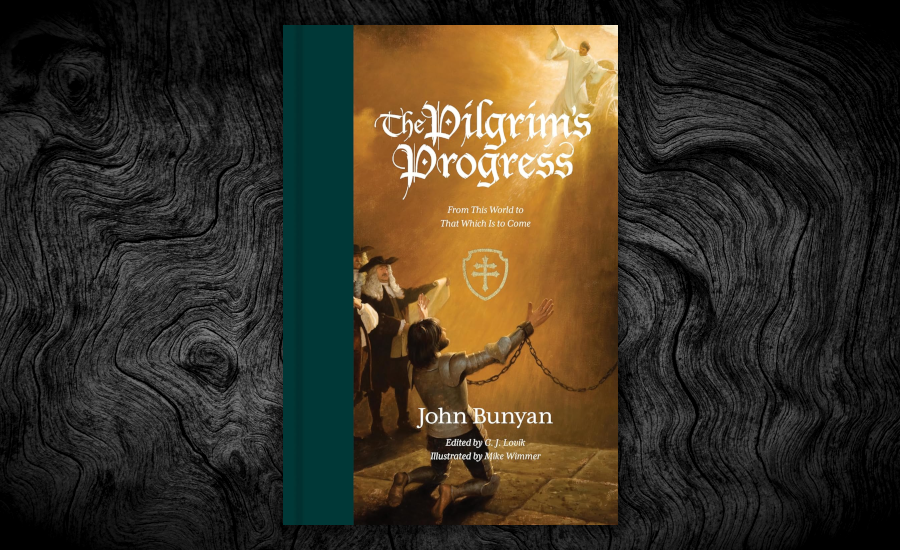
Note: There are many fine editions of Pilgrim’s Progress. The one in the picture is my personal favorite, edited by C. J. Lovik with illustrations by Mike Wimmer.