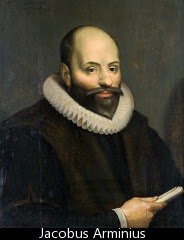
 The following is by Dan Chapa of the Society of Evangelical Arminians (SEA). Since theologically serious alternatives to Calvinism seem to be in short supply these days, SharperIron contacted SEA recently about the possibility of representing classical Arminianism for the SI audience. To learn more about the SEA, see their About Us page.
Arminianism is a summary of our understanding of the Scripture’s teaching on salvation. The name comes from Jacob Arminius, who led 17th century opposition to Calvinism, but the idea stems from Scripture and has deep roots in the early church fathers. Many non-Arminians have mistaken notions about Arminianism—as do many Arminians. This post will define and defend the essential aspects of Arminianism (total depravity, resistible grace, unlimited atonement and conditional election), without critiquing Calvinism.
Total Depravity
Both Calvinists and Arminians believe in total depravity—the idea that fallen man requires God’s grace through the beginning, middle and end of the salvation process. Adam’s fall left us unable, of our own strength, to repent and believe or live a life pleasing to God. But total depravity is not utter depravity; the lost don’t commit the worst sins possible on every occasion. Still without God’s grace, sin impacts every aspect of life and we cannot seek God on our own. Rather, He seeks us and enables us to believe.
Resistible Grace
Arminians may vary on exactly how God’s grace works; but all Arminians hold to the necessity of prevenient grace (grace that comes before conversion that enables us to believe). When God’s grace starts drawing us to conversion, we can choose to say no and reject Christ. God hasn’t predetermined repentance and faith; nothing causes these such that rejection is impossible and we cannot choose otherwise. But believing does not earn or cause salvation; God chooses to have mercy on believers.
Arminians find resistible grace in passages speaking of God’s grace and man’s rejection of it. God is seeking, drawing and inviting mankind to Himself (John 1:9, 4:23, 7:17, 12:32, 16:8; Rom. 2:4, Titus 2:11, Rev. 22:17). In Isaiah 5:4, God asks what more He could have done (showing the sufficiency of His grace) and He invites Israel to judge itself (showing the reasonableness of His requirements). The reasonableness of God’s commands and invitations shows that God treats us as if we can obey Him, which implies that we can, and this harmonizes with our moral intuitions.
In Matthew 11:21, Christ says Tyre and Sidon would have repented if the same works He had done in Chorazin and Bethsaida had been done there. Tyre and Sidon were bywords for sinfulness, so they were neither elect nor regenerate. Yet the same divine works would have brought about repentance in them, showing the fitness of God’s works to bring about repentance and placing the difference in man’s response.
Also, the divine lament passages strongly affirm the resistibility of grace (Ps. 81:13; Luke 13:33-34, 19:41). Some passages plainly say people reject and resist God’s efforts to bring them to Him (Gen. 6:3, Jer. 13:11, Ezek. 24:13, Luke 7:30, Acts 7:51). God hardens hearts by turning over people to their own sinful lusts (Rom. 1:18-28). This implies that God’s grace was softening their hearts and restraining their wickedness. Additionally, the highly controversial Hebrews warning passages (however interpreted) indicate that God’s grace is resistible (Heb. 2:1-3, 3:6-14, 6:4-6, 10:26-29, 12:15). (Most self-identified “Arminians” have held that true believers can forsake Christ and perish as unbelievers, but the earliest formal statement of Arminian theology—the 5 points of the Remonstrants—expressed uncertainty about the point and, conceptually, it is not an essential tenet of Arminian theology.)
Resistible grace often leads to the controversial question of whether faith or regeneration comes first. Some disagreement stems from defining regeneration. Does regeneration include God’s imparting eternal life to us? Does regeneration include God’s enabling belief? Arminians typically answer yes to the first question and no to the second, so naturally we see faith as preceding regeneration. Ephesians 1:13, John 1:12-13, John 5:24-28, Romans 6:2-6, Galatians 3:2 and 2 Corinthians 3:18 support this order. Notice the issue is which grace enables man to believe (prevenient grace or regeneration) not the depth of man’s depravity without grace.
Scriptures say we have wills and choose (Deut. 30:19, Josh. 24:15, 1 Cor. 7:37). “Choose” is normally defined as “to select from a number of possible alternatives” and we reject imposing on Scripture definitions of “choose” that either remove essential elements or are stipulated philosophical definitions. God tests us—whether we will obey or not—which implies that at least sometimes obedience is up to us (Exod. 16:4). God promises that we will not be tempted beyond our abilities (1 Cor. 10:13), which implies that we can choose to obey or not. God’s desire to have a relationship with free creatures magnifies His love, and His ability to providentially govern and rule a world with free creatures magnifies His sovereignty.
Unlimited Atonement
Christ died for everyone. This is not universalism; the benefits of Christ’s death are conditionally applied, not automatically or necessarily applied. Just as the Passover Lamb was slain and the blood applied, so also we distinguish between Christ’s death and the application of His blood to believers. Christ’s death makes salvation possible for all, and God desires all to believe and be saved through His blood, but only believers are actually cleansed by Christ’s blood.
We see conditionality in the application of Christ’s blood because justification is by faith (Rom. 3:21-26) and because Christ died for some who ultimately perish. Christ said to all the apostles, including Judas, my blood is “shed for you” (Luke 22:21-22). The apostates in Hebrews 10:26-29 were sanctified by Christ’s blood. The false prophets in 2 Peter 2:1 denied the Lord that bought them. 1 John 1:7 and Colossians 1:22-23 plainly teach conditionality in the application of Christ’s blood.
The many passages saying Christ died for the world or all men ground our belief that Christ died for everyone (John 1:29, 3:16-17, 4:42, 6:33, 6:51, 12:47; 1 John 2:1-2, 4:14; 2 Cor. 5:14-19; Heb. 2:9; 1 Tim. 2:4-6, 4:10). While “world” has a broad range of meanings, that range does not include any definition that would avoid the conclusion that Christ died for everyone, nor do we see validity in inventing a specially plead definition of world to avoid unlimited atonement. We see Christ’s sacrifice for all as the foundation of the sincere offer of the gospel to all in that everyone can be saved through what Christ accomplished on the cross.
Conditional Election
God gave pre-fallen Adam the ability to obey Him—He wanted Adam to be free to have a relationship with Him. God did not causally determine Adam’s sin such that he couldn’t obey and necessarily fell—such would be inconsistent with God’s holiness and hatred of sin (James 1:13, Jer. 7:31, Ps. 45:7). Thus, Arminians insist that God is not the author of sin, and free will is essential to Arminian theodicy. Our freedom lies between God and sin; otherwise God is ultimately responsible for sin.
In election, God considered man as fallen sinners. God chooses to have mercy (Rom. 9:16). Scripture calls the non-elect vessels of wrath, or appointed to wrath (Rom. 9:22, 1 Thess. 5:9). Now mercy on the one hand, and wrath on the other, presuppose sin. So Arminians view election as fixing the sin problem, rather than seeing the fall as something God planned in order to accomplish His goal of sending His chosen to heaven and the rest to hell.
Election automatically excluded unbelievers. So we see symmetry in some essential respects between election and non-election. Hellfire is a punishment for sins, so rejection is conditional on unbelief and impenitence.
Freely fallen sinners is one starting point in explaining election—God’s amazing love is another. He does not desire the death of the wicked, nor is He willing that any should perish, but rather He wills all men to be saved and come to the knowledge of the truth. (Ezek. 33:11, 2 Peter 3:9, 1 Tim. 2:4-6). God’s love of the world moved Him to send His Son so that the world through Him might be saved (John 3:16-17). Given man’s fall, the Father chose His Son as the basis and foundation for salvation, and our election is in Him (Matt. 12:18; 1 Pet. 1:20, 2:4; Eph. 1:4).
Just as rejection is conditional, based on sin and impenitence, election to salvation is likewise conditional, not based on works or merit, but based on God’s choice to have mercy on believers. Scripture describes predestination as God’s choosing to save those who believe (1 Cor. 1:21, 2:7); election is said to be in sanctification and in belief in the truth (1 Pet. 1:2, 2 Thess. 2:13). Conditional election includes God’s plan from before time to save through the gospel. Before the foundation of the world, God, in Christ, chose to glorify Himself by saving believers out of fallen mankind.
While all Arminians agree that election is Christocentric and conditional, Arminians may disagree on whether election is primarily corporate (election of the Church as a group with individuals sharing in the group’s election by faith) or primarily based on God’s foreknowledge of each individual’s faith.
Closing Thoughts
When I was first challenged by a Calvinist friend regarding Romans 9, I couldn’t explain the passage. And since his explanation made sense, I reluctantly accepted Calvinism. Then one night, I was shocked by the warning in Hebrews 10 and decided to devote time to digging into Scripture on the issues. I studied for years and came out of that process an Arminian. It was difficult; Arminian resources were scarce and Arminians scarcer still. SEA fixes all of that, giving us resources and a community in which to build each other up. Space hasn’t permitted a detailed exegesis of each of the passages cited, but much more detail is available on the SEA website.

Discussion
NewAn opportunity
Since this particular essay doesn’t aim to critique Calvinism, it might also be helpful if the discussion focuses more on clarifying understanding of the Arminian view and not so much on critiquing it.
(I have to say I really like Jacobus’ haircut)
Views expressed are always my own and not my employer's, my church's, my family's, my neighbors', or my pets'. The house plants have authorized me to speak for them, however, and they always agree with me.
NewA Question For Clarification Purposes
Dan, I really enjoyed your article. Thank you for keeping it warmly factual. I have a religious background grounded in Arminianism, (though I didn’t hear that term until later) but I have since become to believe in parts of Calvinism. I appreciate the rare opportunity to ask a question from a fellow believer with a different viewpoint without the baggage or the same presuppositions.
This article comes at welcome time in my family’s lives because we recently had our previous pastor and his family come and stay with us for a week—he teaches at an IFB college. We had a wonderful time—they are lovely Christians and continue to love us dearly. We benefited greatly from their ministry and their stay with us in our home. As expected, discussions of our current understanding of Scripture took place and my husband did a good job of explaining our current position while graciously receiving a different viewpoint. Our previous pastor did likewise and so it was a discussion grounded in love and grace for one another and never ended up heated or really cold. God is good!
One area touched on was Rom. 9:12-13, and our p.p. stated that the verses had to do with serving and not salvation. If possible, do you mind expounding on that specific topic, if it’s something that’s part of the Arminian defense from Scripture? Or was that specific to a personal viewpoint? We were interrupted and never had a chance to revisit it.
Thank you,
Kim :)
NewThree Cheers for Healthy Adult Dialogue!
NewHear! Hear!
So I appreciate a classic Arminian voice. Still, in the end, I found the SEA folks’ exegesis of John 6 and Romans 9 unpersuasive, just as I find limited atonement poorly supported by the totality of Scripture. So I am a contented “four-pointer.”
I do think the issues are important, however, and that is why a certain vehemence often arises from the discussion of God’s sovereignty in salvation. I think the complexity of the matter adds to the tension. It is hard to have a short conversation between a committed Calvinist and a committed Arminian. It’s even harder with the folks that say “Both are true.” :~
NewQuestions welcome
God be with you,
Dan
NewRomans 9:12-13
Sounds like a great with some good friends. As for Romans 9:12-13, Arminians have a number of slightly different views – there is no one official position.
If you look at the OT testament texts cited by Paul (both Genesis 25:23 and Malachi 1:2), clearly they were speaking of Jacob and Esau as the heads of nations. Further, Esau never served Jacob in his life, but his descendents did. However, Paul does seem to be using Jacob and Esau as an analogy to make some broader point than just blessings given to Nations. But analogies are flexible and that’s why there is some variety in the way the passage is explained.
For my part, all I think Paul is saying via the analogy of God’s election of Jacob and rejection of Esau is that God planned all along to save by grace rather than nationality or the works of the law. In other words, it’s about how God saves, not who He saves. However, other Arminians have suggested:
1) God chose to bless the Nation of Israel with a special but non-saving grace, -this is Robert Hamilton’s view ( http://evangelicalarminians.org/node/263] link )
2) God chose to save through the Gospel, and - this is Arminius’ view ( http://evangelicalarminians.org/files/Arminius.%20ANALYSIS%20OF%20THE%2…] link )
3) God’s election here is primarily corporate rather than individual. – here is Keith Schooley’s presentation on this ( http://evangelicalarminians.org/node/286] link )
Hope that helps.
God be with you,
Dan
NewThanks
Thanks for your efforts to bring this stuff forward. I support these efforts.
Two years ago, I addressed the topic of Calvinist / Arminian relations at the Standpoint Conference. I think both sides have been too swift to a). use straw man arguments, b). point to the rabid extremes of both camps in attacking the other side, and c). arrogantly assume that their tradition holds all the answers.
The fact that the discussion/debate/war has gone on so long suggests that neither system is sufficient to fully explain everything that is going on in the Scriptures with regard to soteriology.
The logic of both sides in debate seems to be “I have this system that explains so many verses I have examined. It all makes sense. So now, I will hammer into compliance these few verses that don’t quite fit my system.”
Give me permission to examine any system, accepting the evidence that supports a thesis and explaining away the evidence that does not, and I can prove anything!
Mike D
NewOverlap
I agree with you overall assessment but I did want to point out why I also tend to focus on ‘extreme Calvinists’ (not hyper Calvinists but ones either strongly critique Arminianism or those holding to supra-lapsarianism or double predestination or those clearly denials of free will). If you looked at Calvinism and Arminianism as overlapping circles, the overlapping portion would be huge. And if time is spent on the outer edge, it may seem like hair-splitting, but really you somewhat have to because 1) in contrast there is clarity and 2) the ‘proof’ of one system or the other is in the outer- edge.
On the other hand, if someone only bringing up Servetus, you could be in for a rough ride. :-)
God be with you,
Dan
NewConditional Election
Or have I misunderstood the Arminian view?
Thanks for posting this article. It is helpful to see these positions spelled out and discussed.
Cordially,
Greg Barkman
G. N. Barkman
Newratification
There may be an aspect of foreknowledge based election that looks like ‘ratification’ but other aspects do not, so to summarize the whole as ratification would be misleading.
God chose to have mercy on believers. He could have chosen to save via works or baptism or saying the word blue three times in a row. But He chose faith as the condition – and this aspect of election has nothing to do with ratification.
Now choosing faith as the condition means that believers are His people. Thus all He foreknows as believers are elect as a result of God’s choice to have mercy on believers. Could this be called ratification? Maybe, but only in a remote sense.
But what did He choose to do? Have mercy. And merciful gifts (adoption, sanctification…) cannot be viewed as ratification – either in God’s plan to give them or His actually giving them.
God be with you,
Dan
NewArminius' view of Election
Arminius looked at election from a two fold perspective, one being a sovereign decree before the foundations of the world as scripture teaches and the other conditioned upon faithfulness. There is an eternal foreknowledge element to this, not in the temporal manner of a “peering through the annals of time” perspective as Adrian Rogers was known to suggest, but a foreknowledge that is of an eternal nature. God knows all that is to be known and did not or does not have to “do something” to know it. It is the all encompassing characteristic of omniscience. My Molinist friends might disagree with that perspective but I think Arminius’ reply to the inquiries regarding Election make the matter clearer than I can elucidate. Here is the perspective from Arminius’ Nine Questions presented to the curators of the University of Leyden in 1605.
1. Which is first, Election, or Faith Truly Foreseen, so that God elected his people according to faith foreseen?
2. Is the decree “for bestowing Faith on any one,” previous to that by which is appointed “the Necessity of Faith to salvation?”
ANSWER TO THIS QUESTION
The equivocation in the word “Election,” makes it impossible to answer this question in any other manner, than by distinction. If therefore “Election” denotes “the decree which is according to election concerning the justification and salvation of believers.” I say Election is prior to Faith, as being that by which Faith is appointed as the means of obtaining salvation. But if it signifies “the decree by which God determines to bestow salvation on some one,” then Faith foreseen is prior to Election. For as believers alone are saved, so only believers are predestinated to salvation. But the Scriptures know no Election, by which God precisely and absolutely has determined to save anyone without having first considered him as a believer. For such an Election would be at variance with the decree by which he hath determined to save none but believers. http://wesley.nnu.edu/arminianism/the-works-of-james-arminius/volume-1/…
Of course, this is the Classical or Reformed Arminian perspective. Others might disagree with elements of this but I believe most would agree that the central theme of election is the salvation of believers who persevere to the trump of the LORD.
Kudos to Dan and Aaron for this effort!
NewClarification
I agree, and your statement made me realize that I need to clarify my statement that “both sides contribute legitimate perspectives.” I meant that both sides have some perspectives that are worthy of consideration, not that every perspective of each side is equally valid.
NewContingency and Aseity
“To these succeeds the fourth decree, by which God decreed to save and damn certain
particular persons. This decree has its foundation in the foreknowledge of God, by which he knew
from all eternity those individuals who would, through his preventing grace, believe, and, through
his subsequent grace would persevere, according to the before described administration of those
means which are suitable and proper for conversion and faith; and, by which foreknowledge, he
likewise knew those who would not believe and persevere.”
Arminius apparently is arguing that God’s knowledge/foreknowledge is contingent upon man’s choice. God knows what man will freely (when his will is inclined towards God by prevenient grace) choose. Thus, God’s knowledge is based upon the free choice of man. How then do those who hold an Arminian position maintain the aseity and independence of God?
NewHopefully this well written
As pointed out, the essay contains views that are a departure from or modification of classic Arminianism. Additionally, while it may serve as a reference point for many the proprietary views and arguments of others must be observed and not presumed against. So, if one wishes to be called an Arminian then clearly this is what they wish for a tag (and they do appear to have some well thought out proponents of that system). But again, not all non-Calvinists, though possibly appreciating some of these arguments and holding to some in part, should be viewed categorically as de facto Arminians and in fact, reject, for many reasons, identification with Arminianism and particularly due to Arminus’ theology as a whole.
My blog: http://thepedestrianchristian.blogspot.com/
NewWeighing in on lunch
I saw this:My understanding of Arminianism is that all true believers are saved and that the salvation is permanent (John 10:22-30, Romans 8:26-39), but the real problem is discerning between the unsaved who think that they are believers and the true believers who are in fact saved. I would disagree strongly with the idea that believers can be lost or fall away from God’s grace.
There are many passages that I’m thinking of, including many of Christ’s parables, but especially Matthew 25 (the parables of the Ten Virgins, Talents, and the teaching on the final judgment.)
"Our task today is to tell people — who no longer know what sin is...no longer see themselves as sinners, and no longer have room for these categories — that Christ died for sins of which they do not think they’re guilty." - David Wells
NewAseity
Well I was hoping to avoid metaphysics, but here goes.
Two ways, first God gives and sustains man’s freedom and free acts. Second, although God’s knowledge of X is explained based on its correspondence to X, it’s not caused by X. Rather, God’s knowledge is infinite and immediate.
But more generally, this aseity argement itself always to me to be on the verge of collapsing into the idea that God cannot know anything outside of Himself.
God be with you,
Dan
NewCAWatson wrote: Arminius
That’s a good question, and I’m happy to take a stab at it for you.
The answer is simply because God knows both possibilities - one possible sphere where person A chooses to repent after finding a tract, and another possibility where everything is exactly the same except person A refuses to repent after finding the tract. In both spheres, all things are exactly equal, and yet God is able to know and act within both realms where person A makes their decision. In no way is God’s independence is impugned, and I Tim. 4:9-10 also remains true. This is why passages like Matthew 23:37-39 are so important…if someone rejects the gospel or rejects the repentance of Christ, it is still their own guilt, and it is not on God.
Make sense?
"Our task today is to tell people — who no longer know what sin is...no longer see themselves as sinners, and no longer have room for these categories — that Christ died for sins of which they do not think they’re guilty." - David Wells
Newnon-Calvinist = Arminian?
To be clear, I am a classical Arminian and the essay hasn’t diverged from that.
I agree with you that not all non-Calvinists should be classified as Arminians. That goes for Arminianism as defined as a historical movement or a theological system). However, it does seem to me that many people who hold to Arminianism don’t claim the name. I always have worried more about what people think more than how they label themselves – but if the term comes up, might as well be accurate, right?
God be with you,
Dan
NewEternal Security
Some Arminians hold to eternal security, and some don’t. I do. If you would like to explore the ‘falling from grace’ viewpoint, please let me know and I will try to find someone at SEA that holds that view who willing to speak with you about it.
God be with you,
Dan
NewDan, I'm curious how an
I’m curious how an Arminian arrives at eternal security? At what point does man lose his free will and ability to reject what he previously freely accepted?
Why is it that my voice always seems to be loudest when I am saying the dumbest things?
NewES and Arminianism
That’s a good question. It’s true that ‘falling from grace’ is a simpler fit with Arminianism than eternal security. But complexity isn’t the same as inconsistency – complexity is in degrees but ideas are either consistency or they are not.
God can prevent anything – this is consistent with free will. So He can prevent apostasy. He could even take me out of this life just I fell away. What God cannot do is make someone freely do something (that’s a contradiction). So while God can’t make everyone freely believe, He can prevent believers from apostatizing.
The ‘shall never perish’ passages were the ones that convinced me that eternal security is true.
God be with you,
Dan
NewAnother POV on security
I suppose some might see this as an end of free will, but even so, I believe there is no reason Arminianism cannot accommodate a free choice that thereafter results in loss of freedom.
For example, I’m free to join the army or not. Once I join, I’m not free to decide what orders to follow. The analogy is imperfect because nobody is circumventing my capacity to choose, but the cost of choosing insubordination is designed to be high enough to motive compliance. I’m not free to disobey orders and still remain in good standing. That much is impossible…. rendered so by my previous choice.
Maybe a better analogy is if I choose to have a limb amputated. Nobody could make me do it, but if it made sense for health reasons, I might freely choose to have my right leg removed. After that, I am no longer “free” to hop on my right leg.
(As a Calvinist on this point, I believe the sinner’s will is not “free” to choose repentance in much the same way… except that we start out amputated: we cannot hop on our right leg (choose repentance) because we are born without one. God graciously does the surgery to provide that missing limb and then—in Calvinism—all who have a right leg do invariably hop on it. My understanding of Arminianism is that the grace that provides the new leg is given to all and then the question is “Will they hop or not?” Kind of a silly analogy but it works sort of.)
Views expressed are always my own and not my employer's, my church's, my family's, my neighbors', or my pets'. The house plants have authorized me to speak for them, however, and they always agree with me.
NewRegeneration or Providence
That’s a great point. I am sure we could do a whole discussion just on perserveriance and I certainly don’t mean to do that, but I did want to comment on this quickly.
There is a question among OSAS Arminians as to the nature of our security. Is it based in regeneration or God’s providence? Is His grace that secures us something that is internal to us or something external to us? Are we like an invincible juggernaut pushed by God through any obstacle or rather is He in front of us knocking obstacles out of the way?
I think it’s external and based on God’s foreknowldge and providence and I worry the internal regeneration based model would interfere with our free will.
God be with you,
Dan
NewArticle 5 on Perserveriance
ART. V. That those who an incorporated into Christ by a true faith, and have thereby become partakers of his lifegiving spirit, have thereby full power to strive against Satan, sin, the world, and their own flesh, and to win the victory, it being well understood that it is ever through the assisting grace of the Holy Ghost; and that Jesus Christ assists them through his Spirit in all temptations, extends to them his hand; and if only they are ready for the conflict. and desire his help, and are not inactive, keeps them from falling, so that they, by no craft or power of Satan, can be misled, nor plucked out of Christ’s hands, according to the word of Christ, John x. 28: “Neither shall any man pluck them out of my hand.” But whether they are capable. through negligence, of forsaking again the first beginnings of their life in Christ, of again returning to this present evil world, of turning away from the holy doctrine which was delivered them, of losing a good conscience, of becoming devoid of grace, that must be more particularly determined out of the Holy Scriptures before we ourselves can teach it with the full persuasion of our minds. ( http://www.ccel.org/s/schaff/encyc/encyc09/htm/iv.vii.cliii.htm link )
NewMike Durning wrote: Dan and
NewConditional Election Again
Thank you for responding to my post regarding conditional election and ratification. I have read our response several times, and I am mystified. It sounds to me like you are saying that ratification does characterize your position, but you would prefer not to think of it that way.
But what else can it be? If election is based upon God’s foreknowledge of who would believe as a result of prevenient grace, in what sense does God choose? If election is of believers, as you say, it has to follow man’s free will choice to believe. If based upon man’s choice to believe, isn’t it really ratifying man’s choice? I am having trouble viewing it in any other way.
Thanks for the exchange.
Warm regards,
Greg Barkman
G. N. Barkman
NewHannah...
But I appreciate your clarification!
NewRatification
Perhaps an analogy might help. In this year’s draft, the Dallas Cowboys selected the best offensive tackle available – Tyron Smith. Now they could have chosen a wider receiver or running back or another position. But they planed to take the best tackle on the board. Now there may be some limited sense in which one aspect of the draft the boys were just ratifying Tyron Smith’s choice to be a tackle, but the headlines read ‘the Cowboys select offensive tackle Tyron Smith’.
Conditional choices are well, choices. We normally choose things for a reason related to the thing we are choosing - unless we are picking randomly (i.e. which nail out of can of similar nails to use).
God be with you,
Dan
NewThinking Arminians Have An Important Perspective to Offer
For example, Ecclesiastes implies God’s sovereign control, and then talks about chance in Ecclesiastes 9:11 :As one who believes in Sovereign Grace, I think we have over emphasized God’s sovereignty more than the Scriptures do. At least I have.
"The Midrash Detective"
Newto expand...
Of course I would have preferred that Dallas drafted all punters, but that’s just me. :)
"Our task today is to tell people — who no longer know what sin is...no longer see themselves as sinners, and no longer have room for these categories — that Christ died for sins of which they do not think they’re guilty." - David Wells
NewJay, Quote: Of course I
God be with you,
Dan
Newparadox
God be with you,
Dan
Newdanchapa wrote:He could have
NewGod's choice of how to save
Well I think it’s biblical to speak of God’s choosing to save through faith (1 Cor. 1:21). But it appears inconsistent to me to say God had to save through faith but He was free to choose who He did.
God be with you,
Dan
NewClarification on Paradox
On the other hand, many Calvinists have invoked paradox (or antinomy) to explain the compatibility of unconditional election with human responsibility. Examples of this include J. I. Packer, Evangelism and the Sovereignty of God; Henry Krabbendam, Sovereignty and Responsibility ( http://www.worldevangelicals.org/lausanne/data/resources/Henry%20Krabbe…] read online here ); and James Anderson, Paradox in Christian Theology.
Ed, as surprising as this sounds coming from me, I completely agree that the emphasis on “Calvinism” does not produce the fruit proponents have proffered. I think that’s because some people have tried to embrace the so-called “5 points” without actually embracing Reformed theology, which grounds and directs those points in a robust, well-balanced manner. These days I’m more wary of Calvinist Baptists than I am of Arminians.
My Blog: http://dearreaderblog.com
Cor meum tibi offero Domine prompte et sincere. ~ John Calvin
NewArminianism and Aseity
http://arminianperspectives.wordpress.com/2011/02/27/the-fallacies-of-c… The Fallacies of Calvinist Apologetics - Fallacy #11: The Arminian View of Divine Foreknowledge Attacks God’s Aseity
You might also want to see:
http://arminianperspectives.wordpress.com/2011/03/02/the-fallacies-of-c… The Fallacies of Calvinist Apologetics - Fallacies #12 & #13: The Arminian View of Divine Foreknowledge Attacks God’s Simplicity and Immutability
NewResponse to a few comments ...
It also reminds me again that people who claim not to be something usually are. They just either don’t know it, or don’t want to claim it because they don’t want a man’s name attached to their beliefs. But a rose by any other name smells just as sweet … so denying that one is Arminian or Calvinist or Pelagian is actually irrelevant. I think it tends just to make one look uninformed. What you believe is what determines whether or not one fits the category, not whether or not one accepts the label.This is always a bit strange to me, though I have seen it other places as well. For me, the hermeneutic that makes me Calvinistic in my soteriology is the same hermeneutic that makes me dispensationalist and Baptist. I think this was the idea behind MacArthur’s infamous message a couple years ago at the Shepherd’s conference. I don’t find full orbed reformed theology to be balanced and robust at all. I find it filled with exegetical problems and inconsistencies (which others say about my dispensationalism, which is fine with me). I remember one professor saying that Reformed theology is a great theological construct. It just isn’t a good exegetical one.
A final note, here are two issues that perhaps danchapa can address in some way.
First, I am always curious about those who affirm Arminianism in an attempt to protect the free will of man to choose without being forced. But they do not seem to show the same respect for God’s free will. Why should God be “un”-free while man is free (assuming that if man chooses God, God is not free to reject that man)? Why should God be forced to respond only to man’s “free will choices,” but man should not be forced to respond to God’s free will choices? Why is man’s free will protected at the expense of God’s?
Secondly, I am unconvinced that the typical arminian idea of foreknowledge actually helps protects man’s freedom. If God is omniscient (always knowing all things from eternity past), then he knows who will believe (and so He chooses them … is that really a choice if He can’t not choose them?). If he knows that “Bob” will believe at some point in his life (say the summer of 2011), is Bob actually free to change his mind? If God’s knowledge is accurate, then it seems that Bob is not free to change his mind in the summer of 2011 (or anytime before or after that; IOW, he can’t believe in the spring of 2011 or the fall of 2012). If, on the other hand, Bob is actually free and has the ability to either believe or not believe, then God’s knowledge is at least possibly wrong. Dan, can you help me understand how you would answer this?
(I realize that I have just presented a case that all whose overriding aim in the “election discussion” is to protect man’s free will must become open theists to be consistent, and I am aware that the same type of argument is leveled about Calvinism and hyper-Calvinism. But I am just looking to see how Dan addresses this.)
NewMy thanks to Brother Chapa
I’m sure there will be some who, after reading the article, will be faced with a personal conflict. They will admit that the article states their position but will deny that they are Arminian.
"Some things are of that nature as to make one's fancy chuckle, while his heart doth ache." John Bunyan
NewWhich mystery?
That’s a good point. There’s a big difference between saying both Calvinism and Arminianism have some truths and it’s a mystery and saying Calvinism is true and it’s a mystery as to how man is responsible for his actions. Both Van Til and Clark were Calvinists.
God be with you,
Dan
NewGod un-free?
Warning, the following falls under ‘musing’.
God’s various choices are interconnected in various ways and at some level may be looked at as one big choice for His entire plan. While we (given our limitations) look at different aspects as distinct in a logical order (and with different effects at various moments in time), in and of it’s self it’s all one. So while God’s choice to save believers logically precedes His choice to save this or that individual, it’s really all part of God’s master plan which He chose in total.
God be with you,
Dan
NewThanks Dan for the gracious
Second, what I am asking is why God’s freedom to choose is subjugated to man’s freedom to choose? If God chooses man and man has to accept, then people say man’s free will is violated. But if man chooses God and God has to accept, God’s free will is never even brought into the discussion. So why is it okay to bind God’s free will to man’s choice but not bind man’s free will to God’s choice?
NewForeknowledge argument
I categorize foreknowledge arguments into two kinds, general intuitive appeals and structured logical proofs. General intuitive appeals are simple to understand and quite powerful. Your argument here is a good example. If you had intended this to be a rigorous logical proof, I would say the problem is that there’s a distinction between ‘will not’ and ‘can not’ so your conclusion does not follow. But I think a lot of people would be left with some question as to if the issue runs deeper.
On the other hand, if something is ‘obviously wrong’ it should be simple enough to structure some logical proof walking step by step through true premises to a valid conclusion. And I have reviewed many such attempts – all of which have some fatal flaw. And because of the failures of the structured logical proofs, I worry that the general foreknowledge argument confuses people rather than sheds light on the issue.
Here’s a few distinctions I have found helpful in overcoming various foreknowledge arguments:
1) Will not vs. can not (self explanatory, I think)
2) Certainty vs. necessity (i.e. in God’s mind vs. in the thing itself)
3) Logical impossibility vs. causal impossibility (i.e. a contradiction vs. a lack of power in an agent)
4) Truth vs. the basis of truth (the proposition ‘Bob is eating an ice cream cone’ vs. Bob himself eating the ice cream cone’)
5) Sufficient conditions and sufficient causes (i.e. given proposition X, proposition Y is logically deductable vs. given event X, event Y always happens
6) The ability to cause X vs. the ability to change propositions about X from possibly true to actual true
7) Divided and compound sense (statements about one thing verse statements about the combination of two things)
I personally haven’t seen a foreknowledge argument that runs afoul of one of these distinctions.
God be with you,
Dan
NewThanks Ron, hopefully I will
God be with you,
Dan
NewCan God Still Be God?
atdCross http://atdcross.blogspot.com/ http://evangelicalarminians.org/
NewFootball Illustration
Thanks for the election illustration. I must say, it doesn’t seem to me to address the question, but rather than debate an illustration, maybe you could offer clarification on the way you understand election. Do you view election as choosing individuals, or something else?
Thanks for the opportunity to discuss these doctrines.
Cordially,
Greg Barkman
G. N. Barkman
NewGod Does Whatever He Chooses
G. N. Barkman
NewParadox Again
But Charlie, the word “robust?”
As far as paradox, I am more and more impressed with a view I used to hold to decades ago, that these are indeed a paradox (the Arminian and Calvinistic perspective) and that they do, in fact, reconcile in heaven much as the Trinity does. It is one thing to say that something is not logical on a human plane with all our limitations of understanding. What we mean is that we cannot see the logic; that does not mean it is illogical. A man from the 15th century would think the workings of a computer make no logical sense, but they do. Leaving room for the limitations of human knowledge and ability to reason is not escape from reason, although it can be.
When you try to explain the boundaries of the Trinity to a Jehovah’s Witness, they will comment, “that’s not logical.’ And, in a sense, they are right. But then again they are wrong: it is logical, just beyond us. That is what I am saying with the paradox concept. As you mentioned, J.I. Packer does that (I remember reading his books decades ago) as do many others (although not with all the points of Arminianism).
"The Midrash Detective"
NewRight On
"The Midrash Detective"
NewGod Does Whatever He Chooses To Do
If God deems that His justice is satisfied by nailing a rabbit to the Cross and/or having the objects of His mercy say “Blue” three times, freely choosing to save man as sinners on one or both of these terms, how can we deny God’s freedom to do so and render such means as unsatisfactory?
Who and by what authority does one have to tell God how men ought to be saved?
atdCross http://atdcross.blogspot.com/ http://evangelicalarminians.org/
NewThe impossibility of middle ground or paradox
i would have to disagree that a paradox between Arminianism and Calvinism makes sense. In order to do so, one would have to reduce both systems to specific ideas, and ignore the nuances within those systems.
Personally, I don’t believe that a middle ground can exist between the two, or that paradox makes sense, because the two positions are too similar. It is like finding the middle ground between the living room and the hallway: there just isn’t enough space there. On the other hand, they are devided by a wall: election is either conditional or unconditional, and saving grace can either be resisted or not. Why or how election is conditional or unconditional can be varied, but you are on one side or the other.
your brother in Christ, Martin Alpha and omega forever