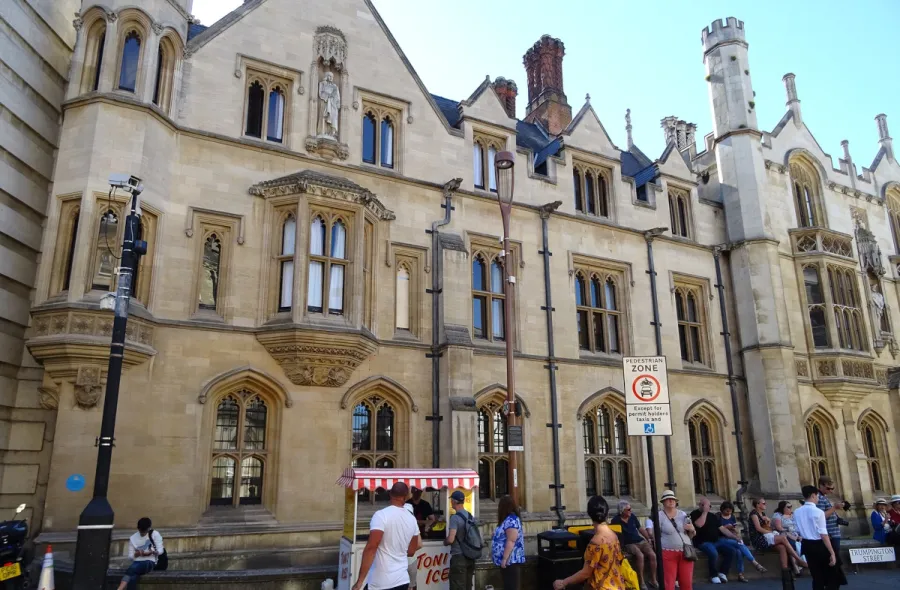
The White Horse Inn. Photo: Spudgun67, CC BY-SA 4.0, via Wikimedia Commons
Image
Read the series.
Historians’ best guess is that William Tyndale was born in 1494—11 years after Martin Luther—making him a mere 42 years old when he was martyred on Oct. 6, 1536.
He undertook a classical education at the University of Oxford—a few decades more than a century after John Wycliffe, the “Morning Star of the Reformation,” had made his impact. One scholar believes that Tyndale was only 14 years old when he commenced his studies there.1 It is commonly accepted that he received a bachelor of arts degree in 1512, and a master of arts degree in 1515.
David Daniell writes:
… Tyndale would have spent his time for the BA listening to lectures on the trivium (grammar, rhetoric, logic) and the quadrivium (arithmetic, music, geometry and astronomy) given by masters or bachelors on the days prescribed. … For the MA, the three philosophies, natural, moral and metaphysical, were taught over eight terms, and were almost wholly dependent on Aristotle.2
This accords with the famous statement of John Foxe, when he wrote:
William Tyndale, the faithful minister and constant martyr of Christ, was born about the borders of Wales, and brought up from a child in the university of Oxford, where he grew up, and increased in the knowledge of tongues and other liberal arts, but more especially in the knowledge of the Scriptures, to which his mind was singularly addicted.3
Tyndale actually became fluent in eight tongues: Hebrew, Greek, Latin, French, German, Italian, Spanish and, of course, English.
Yet, as Daniell concedes, “There is much that is not known about Tyndale in Oxford.”4
It appears, however, that his most spiritually formative years may have been spent at Cambridge, where he began to interact with the New Learning from out east, in Wittenberg, and became one of the Germans, or Little Germany—the group that met clandestinely in a parlor room at the White Horse Inn.5
The Lutheran influence in Cambridge was very strong, and it drew Tyndale to come and learn deeply about truths that were gripping his heart and soul and refusing to let go. He is normally placed as being in Cambridge for several years, following his studies at Oxford.
At the White Horse, specifically, he engaged in fellowship and study with his own disciple, Miles Coverdale, as well as the Oxford Martyrs, Nicholas Ridley, Hugh Latimer and Thomas Cranmer, and others, including Robert Barnes and Thomas Bilney.6
We are left only to wonder at the conversations they enjoyed, and the commitments they made, at these sessions—seemingly innocuous meetings of friends, which would actually play a role in shaping the course of Western Civilization.
Except, maybe it never happened that way at all. Daniell admonishes us, writing:
What an assembly of saints! What debates must the White Horse have known! The names peal down the centuries. Unfortunately, … the hard evidence that any of them, in Cambridge, were ever in the same place at the same time, never mind together in the snug of a Tudor pub, is minimal. There is a certain rightness in having Tyndale’s name leading all the rest; but even if it were certain that he was in Cambridge in about 1520, which it is not, there is not a scrap of witness that he even knew where the White Horse was.7
So, is the White Horse Inn just the stuff of fable and lore?8 Or are the details merely hidden from history—just as carefully as they would have been kept from the authorities in the 16th century?
We may never know the answer to that question this side of heaven, but the mythic quality of these meetings—if they happened the way they have been imagined—still haunts us to this day. These men who flirted with death until it caught so many them as martyrs, just so that others might have the gospel and the Scriptures in the English language, continue to inspire the reforming church, and will do so until the Lord returns—even if they never held a meeting in that pub.
Like so much of his life, Tyndale’s time in Cambridge was—perhaps purposely—shrouded in mystery. Did he study there? Did he teach? Was this where he was truly converted?9 In 1521, he went as an ordained priest to serve as a chaplain and tutor for Sir John Walsh at Little Sodbury Manor in Gloucestershire, and to pursue his preaching ministry.
Once again, we turn to the words of John Foxe to find a fitting conclusion:
Since that time, even in recent years, God again had pity of this realm of England, and raised up his prophets; namely, William Tyndale, … with others, who earnestly labored to call us to repentance, so that the fierce wrath of God might be turned away from us.10
May the Lord continue to refine His church, 500 years after Tyndale, and send us new (small “p”) prophets. And, may I be so bold as to pray this—that He might even provide and establish a special meeting place for them, even in the quiet recesses of some pub, like the White Horse Inn.
Notes
1 Peter J. Gurry; “The Life and Legacy of William Tyndale.” Text & Canon Institute; 3 May 2022; https://textandcanon.org/the-life-and-legacy-of-william-tyndale/; Internet; accessed 7 October 2026.
2 David Daniell, William Tyndale: A Biography (New Haven, CT: Yale University Press, 1994), p. 29.
3 John Foxe, The Acts and Monuments (1563). Family edition ed. M. Hobart Seymour (1855). Formatted, corrected, modernized with American spelling by William H. Gross, 23 April 2012. Last updated 16 February 2026. https://www.onthewing.org/user/Foxe%20-%20Acts%20and%20Monuments%20-%20…; Internet; accessed 7 October 2026, p. 1,200.
4 Daniell, p. 39.
5 A popular Christian radio program by this name claims to be “named after the pub in Cambridge, England, where the Reformation came to the English-speaking world” (White Horse Inn; n.d.; https://www.whitehorseinn.org/about/; Internet; accessed 7 October 2026).
6 Foxe makes reference to Edward Crome’s attendance at the pub, calling him, “parson of St Antholin’s Church in London” and stating: “While at Cambridge, he encountered the ideas of religious reformers by attending the meetings of ‘gospellers’ at the White Horse Inn, in St. Benet’s” (p. 1,158).
7 Daniell, p. 50.
8 Daniell states, “Legend has developed the story” (p. 49).
9 Foxe writes of Tyndale: “… increasing more and more in learning in the university of Oxford, he removed from there to the university of Cambridge, where after he had likewise made his abode for some time, and now being further ripened in the knowledge of God’s word, he left that university also….” (p. 1,200).
10 Foxe, p. 117-118.
NKJV - Source
Scripture taken from the New King James Version®. Copyright © 1982 by Thomas Nelson. Used by permission. All rights reserved.
Paul Scharf 2023 bio
Paul J. Scharf (M.A., M.Div., Faith Baptist Theological Seminary) is a church ministries representative for The Friends of Israel Gospel Ministry, based in Wisconsin and serving in the Midwest. For more information on his ministry, visit sermonaudio.com/pscharf or foi.org/scharf, or email [email protected].