Read the series.
Then one of the twelve, called Judas Iscariot, went to the chief priests and said, “What are you willing to give me if I deliver Him to you?” And they counted out to him thirty pieces of silver. So from that time he sought opportunity to betray Him. (Matt. 26:14-16)
Few wounds cut more deeply than betrayal. And few sins carry such a stinging overtone.
Judas, of course, carried out the most notorious betrayal in history, when he promised Christ to the unbelieving authorities of Israel for a meager sum of 30 silver coins—or the amount required to compensate for the loss of a slave (Ex. 21:32).
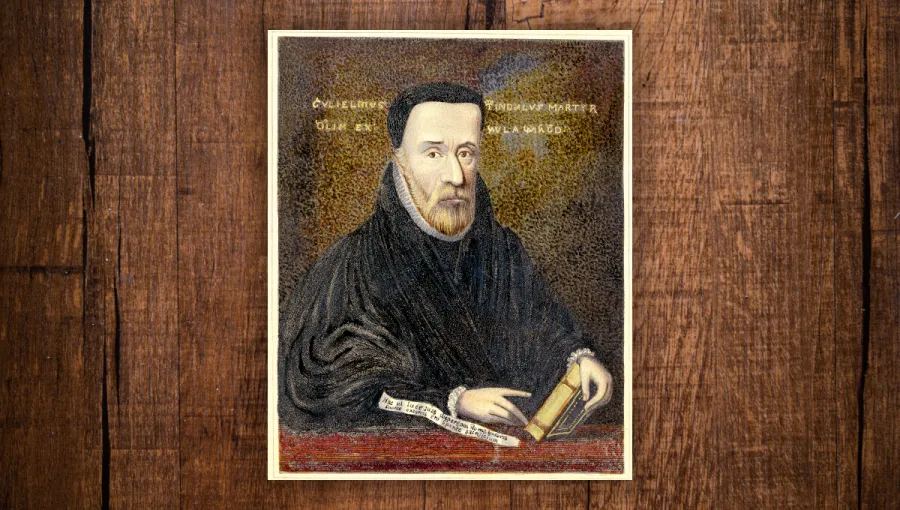
Like his Lord, William Tyndale was also betrayed—by a law student, Henry Phillips.
According to Peter Gurry, Phillips “had left England in disgrace after gambling away his father’s money, [and] feigned friendship and interest in Tyndale and his work.”1
During this time, Tyndale was staying at the English House in Antwerp, under the care of a man named Thomas Pointz. He had been a resident of Belgium since 1528. It was from here that he had completed the revision of his English New Testament in 1534, and had continued to work in the hope of finishing a complete translation of the Old Testament into English.
John Foxe provides this background:
Tyndale was often invited to dinner and supper among the merchants, by means of which this Henry Phillips became acquainted with him. And in a short time Tyndale had great confidence in him, and brought him to his lodging, to the house of Thomas Pointz. He also had him once or twice to dinner and supper. Through means of this Henry Phillips, William Tyndale was betrayed. After dining together at the house of Thomas Pointz, as they were leaving it, Tyndale was seized by two officers whom Phillips had brought there for that purpose. Then this traitor delivered him up to the emperor’s partisans; his books were all seized, and he was himself cast into prison.2
Gurry adds, “In a turn eerily reminiscent of Judas’s betrayal, he turned [Tyndale] over to the authorities for money.”3
Foxe also records:
… Phillips pointed with his finger over Master Tyndale’s head down to him, that the officers who sat at the door might see that it was he whom they should take, … they pitied to see his simplicity when they took him.4
Adding insult to injury on that fateful day, Phillips requested a loan from the good-hearted Tyndale—a large sum of money—knowing it would never have to be repaid.5
Just as when we read the gospel accounts of Jesus’ betrayal, leading to His arrest, suffering and death, so our hearts ache each time we revisit the story of Tyndale’s betrayal. Surely this one “of whom the world was not worthy” (Heb. 11:38) deserved a much greater end to his life and ministry.
What can we take away from his dreadful experience? Here are four lessons that we should learn.
Phillips is the spiritual descendant of Judas.
Also bearing traits of the prodigal son (cf. Luke 15:11-16), Phillips was truly a despicable character. We can hope for his later repentance, and we can also speculate that, lacking this, his remaining years were consumed with either guilt or hardness of heart. He holds a contemptible place in church history.
Tyndale must have been a very likable fellow.
Dinner with Tyndale? Who would not jump at the opportunity? Oh, the stories that must have been told—about the White Horse Inn, Wittenberg, Worms, Hamburg and all places in between, to say nothing of discussions about texts and translations! We can certainly guess that he must have been an affable, humble, and gracious—as well as fascinating—dinner guest.
Tyndale was entirely too trusting.
All the signs of trouble were there. How did Tyndale miss them? Perhaps he was too hopeful. Perhaps he was tired of having his guard up, and wanted to believe that Phillips really was a genuine friend. Jesus taught us to beware of “the sons of this world [who] are more shrewd” (Luke 16:8) compared to His followers.
God had a purpose.
As hard as it is to say—as difficult as it might be to hear—God always has His own purposes. These are based only on “the counsel of His will” (Eph. 1:11) and are far beyond our comprehension (cf. Isa. 55:8-9). It would seem that his purposes for having William Tyndale alive and at liberty to translate the Bible into English were largely finished by May of 1535. His life was not over, but it also would not be fulfilled in the way we would have chosen to write the story.
Tyndale would never be free again after May 21, 1535.6 The events in front of him were truly terrifying from a human perspective. Yet we know “that the sufferings of this present time are not worthy to be compared with the glory which shall be revealed in us” (Rom. 8:18).
We will consider Tyndale’s horrific experience in prison in the next installment.
Notes
1 Peter J. Gurry; “The Life and Legacy of William Tyndale.” Text & Canon Institute; 3 May 2022; https://textandcanon.org/the-life-and-legacy-of-william-tyndale/; Internet; accessed 4 November 2026.
2 John Foxe, The Acts and Monuments (1563). Family edition ed. M. Hobart Seymour (1855). Formatted, corrected, modernized with American spelling by William H. Gross, 23 April 2012. Last updated 16 February 2026. https://www.onthewing.org/user/Foxe%20-%20Acts%20and%20Monuments%20-%20…; Internet; accessed 4 November 2026, p. 1,204.
3 Ibid.
4 Foxe, V, pp. 121-123. As recorded in David Daniell, William Tyndale: A Biography (New Haven, CT: Yale University Press, 1994), p. 364.
5 Adrian Stoutjesdyk; “The Fugitive Translator: William Tyndale’s Dangerous Work.” Trinitarian Bible Society; n.d.; https://www.tbsbibles.org/page/FugitiveTranslator; Internet; accessed 5 November 2026. Edwards lists this amount as “two pounds.” See Brian H. Edwards; “Tyndale’s Betrayal and Death.” Christian History Institute; n.d.; https://christianhistoryinstitute.org/magazine/article/tyndales-betraya…; Internet; accessed 5 November 2026.
6 The date is based on Gurry’s article. See also Edwards, and Daniell, p. 364.