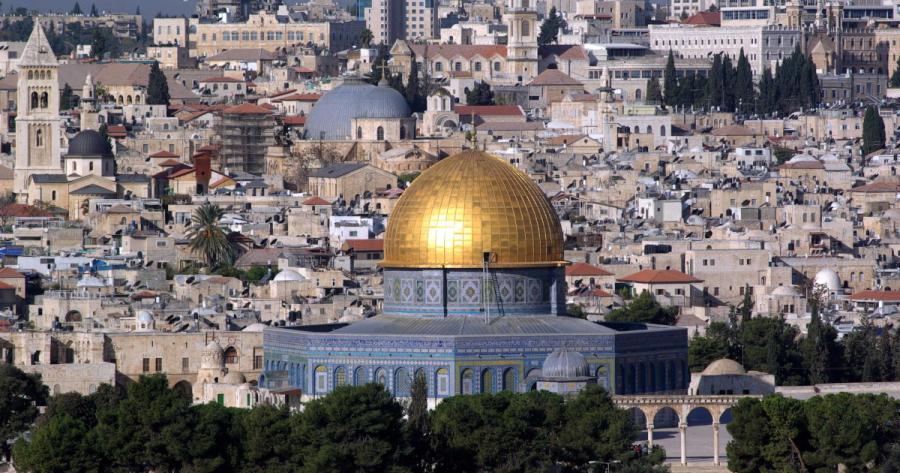
Good Christians disagree about whether the people of Israel have a future in God’s plan because they have very different ways of understanding the Bible’s “big story.” Many Christians believe the people of Israel are important to the Bible’s story. But not all of them know why, other than to correctly declare “Israel is special” or “they’re God’s chosen people.” These are incomplete answers.
There are at least two reasons why we believe the people of Israel are a key part of the Bible’s “big story.”
- To be a blessing. Israel is special because God plans to use her as a vehicle to preach the gospel to the world during Jesus’ 1,000-year millennial reign. It is during the millennium that God fulfills his three big covenant promises to Abraham (Gen 12:1-3)—a great nation, in a land of their own, being a blessing to the world by spreading the gospel about King Jesus. These covenant promises are about “a geographical platform, a land of promise, to serve as a base of operations for God’s kingdom program on earth.”1
- Millennium as a microcosm of paradise. Israel is not an end in and of itself. The millennium is a microcosm or prototype of what the Lord will do in paradise in eternity2—sort of the “spring training” version of the new creation paradise to come. This millennium will feature a great nation of believers, in a new and perfect land, with Jesus (“the son of Abraham,” Mt 1:1) as the penultimate Abrahamic blessing to the world.
But other Christians disagree. They believe there will be no millennium, and a very different fulfillment of those three “big promises” to Abraham. They believe Israel no longer has a unique role to play in reconciling the world to King Jesus. So, rather than seeing the great nation + land + be a blessing promises as means God will use to reach the world for the Messiah, they see them as shadows pointing to the greater realities which Christ makes real, both now and in paradise. Although these good Christians arrive at the same place—Jesus will return to punish the wicked, reward the righteous, and usher in eternity—they take a very different route to get there.
Many Christians believe the New Testament sheds new light on God’s covenant promises. They say this so-called “new light” changes what these promises mean in a way the original audience wouldn’t have understood, and in a way that violates the normal sense of the words God used to make those promises. They believe the Bible does this by one thing foreshadowing another—which is when one thing points to another thing bigger than itself (this is also called “typology”).
- For example, Adam (our first representative), Moses (the great prophet), and David (the king of Israel) each foreshadow Jesus in complementary ways.
- The tabernacle is a figure of the real throne room in heaven.
- Christ also fulfills larger old covenant events in Scripture which the prophets heralded; the old Eden v. the new Eden, fall v. atonement; Exodus from Egypt v. exodus from Satan’s grasp, etc.3
This is a real thing in Scripture. But is it a real thing when it comes to God’s covenant promises? Many Christians wrongly say it is.
- Their argument is the big three covenant promises to Abraham (a great nation + in a land of their own + to be a blessing to the world; Gen 12:2-3) are signposts which point to a larger fulfillment.4
- So, they say, God does not replace Israel. Instead, Christ fulfills her promises in a larger way.
So, these Christians interpret in a non-literal way old covenant passages that we believe plainly mean more than that. Many do this because they believe the Bible’s whole story is all about God’s alleged “covenant of grace” with those chosen for salvation.5 “In the New Testament all these types reach their fulfilment and therefore cease.”6
- It’s true that God has a big plan to provide salvation to sinners through faith in Christ.
- But it isn’t true that this means the Bible’s “big story” is basically about you and your personal salvation. This viewpoint interprets everything through the lens of the gospel (Jesus’ life and death),7 when the real “big story” is the new creation paradise God has been bringing about since Genesis 3:15. Yes, Jesus essentially defeats Satan on Easter morning, but the war is not over until Revelation 22.
- This would be like interpreting the Allied victory in Europe during World War 2 entirely from the standpoint of D-Day on 06 Jun 1944. This would be a flattening of reality. Yes, D-Day was a triumph for the Allied cause that spelled the end for Nazi Germany, but the war in Europe didn’t end for another 10 months!
- This popular and helpful (but incomplete) “gospel-centered” lens can lead to a tunnel-vision way of reading the Bible that has the New Testament flattening many Old Testament covenant promises to fit the “Jesus and individual salvation” mold.
This is why many good Christians wrongly flatten and distort God’s covenant promises to mean only this:
|
Great nation |
= |
God’s people—whoever they are (1 Pet 1:9-10) |
|
The land of Canaan |
= |
Paradise in eternity (Rev 21-22) |
|
Israel will be a blessing |
= |
Christ will be a blessing (“son of Abraham,” Mt 1:1) |
|
King over Israel in Canaan |
= |
Jesus over his people in paradise (Rev 21-22) |
We agree that, by time we get to Revelation 21-22, all this is true—the endgame truly is paradise regained, in a new creation, with one body of believers in Christ consisting of two peoples: Israel and the church (see Rev 21:10-14).
And yet … suppose you describe the plot of the 1997 movie Titanic as being “a love story on a ship.” This is true, but very incomplete—you’ve flattened the story into a pancake. This makes Titanic = an episode of The Love Boat. What if you described Harry Potter and the Sorcerer’s Stone as “a wizard kid goes to boarding school”? Or the book of Revelation as “Jesus wins”? These are all true, but really simplistic—so crude they’re wrong even though they’re technically right!
This is why the true disagreement is about the way we think the Bible’s “big story” plays out. We believe God made those “big three” promises to Abraham because he determined that Israel will play a key role in reconciling people from all over the world to Jesus, and she will do this during the 1,000-year millennium. During that time, she will be a great nation, in the land of Canaan, being a blessing to the world by spreading the good news about Jesus the King. Here is one example passage from the prophet Micah that speaks of these events:
And it will come about in the last days That the mountain of the house of the LORD Will be established as the chief of the mountains. It will be raised above the hills, And the peoples will stream to it. Many nations will come and say, “Come and let’s go up to the mountain of the LORD And to the house of the God of Jacob, So that He may teach us about His ways, And that we may walk in His paths.” For from Zion will go forth the law, And the word of the LORD from Jerusalem (Micah 4:1-2).
On our interpretation, Jesus’ millennial reign is a lengthy transition period between this present, evil age (Gal 1:4) and paradise to come. That is the disagreement about the big picture.8 This is why good Christians often talk past one another about the end-times. The other side believes the New Testament, and the apostle Paul in particular,9 provides new understanding of these old covenant promises, and so their shape of the Bible’s “big story” does not include a future mission for the people of Israel, so they see no need for a millennium.
Again, all good Christians have the same finish line: Jesus returns, punishes the wicked, and rewards the righteous. But we have very different ideas about how the big story of the Bible gets to the finish line.
In the next article, we’ll discuss how to rightly understand the Bible’s “big story.”
Notes
1 Michael Vlach, The Bible Storyline (Cary: Theological Studies Press, 2025), 101.
2 Eugene Merrill, “A Theology of the Pentateuch,” in A Biblical Theology of the Old Testament, ed. Roy B. Zuck (Chicago: Moody, 1991), 27.
3 See esp. Graeme Goldsworthy, Gospel-Centered Hermeneutics (Downers Grove: IVP, 2006), 58-66; 245-57. The chart at pp. 253-56 is especially excellent.
4 “These temporal blessings did not constitute an end in themselves, but served to symbolize and typify spiritual and heavenly things” (Berkhof, Systematic, 296).
5 Berkhof argues that the second party to the so-called “covenant of grace” are the elect in Christ (Systematic, 272-76).
6 Berkhof, Systematic, 293.
7 “[T]he gospel is the hermeneutical norm for all of reality … For the student of the Bible, the gospel becomes the norm by which the whole Old Testament and all the exhortations and other non-gospel aspects of the New Testament are to be understood” (Goldsworthy, Gospel-Centered, 63; emphasis in original).
8 “The basic issue is the way we understand the historical plan and the goal of that plan through which God will bring eternal glory to himself” (Saucy, Progressive Dispensationalism, 19).
9 “The best Scriptural exposition of the Abrahamic covenant is contained in Rom. 3 and 4, and Gal. 3” (Berkhof, Systematic, 295-96).

Discussion
NewThere are at least two…
One of the other reasons, maybe a weightier one as far as impact on theological method, is the the desire for a coherent approach to interpreting the character and promises of God as we find them in Scripture, especially the covenants. Because alternative approaches seem to become self-contradictory or their assertions seem to die the death a thousand vaguenesses.
So what words mean becomes so slippery, it at least feels like the hermeneutic is too messy and uncertain.
So I’m just agreeing with this, really…
Agree also with this…
I think there is another ‘why’ worth noting though. Sheer doctrinal/ideological momentum. When the NT church was launched, it was in a strongly Jewish context, as the conflicts in Acts show. And church leaders struggled long on what to do with the continuity question, as we think of it now. There was built in pressure to think of the church as somehow being Israel and the clergy being sort of the new priesthood. Which is where the Roman path went. Then later, when Reformation happens, there is still all the doctrinal momentum of Rome. So various ‘strong continuity’ perspectives continued to dominate, and ‘strong discontinuity’ views were presumed to bear most/all of the burden of proof on the continuity question.
The irony of ‘strong continuity’ is that it results in so much discontinuity of another kind. I.e., a strong continuity of Israel→church and Priesthood→clergy results in a great deal more discontinuity in the story of the Bible as a whole, the covenants, what God means when He makes promises, and of course Israel.
So the ‘continuity vs. discontinuity’ framing isn’t really fair. But it’s useful as a way of looking at “how does the people of God” function post-cross. It just isn’t fair, wholistically, to say dispensationalism has ‘more discontinuity.’ That depends on what variables you include.
Views expressed are always my own and not my employer's, my church's, my family's, my neighbors', or my pets'. The house plants have authorized me to speak for them, however, and they always agree with me.
NewAgreed
I’m addressing a lot of what you say in the next articles in this series. I’m writing them for my church, so hopefully they’re understandable. I plan to cover right presuppositions to interpret the bible, sketch the end-times events in order (thus falling into a stereotype!), present a brief, positive view of the bible’s big story, and talk about the millennium. So, lots of stuff to come.
Tyler is a pastor in Olympia, WA and works in State government.
NewJust not clever enough
My take is that whether the current state of Israel will inherit some of the promises of Scripture or not is beyond my ken (it's troubling that something like 80% are said to be secular, for example), but what I can't ignore is that the prophets speak a lot about the things allocated to Zion, Israel, Jacob, and the like. So there is a certain point (Genesis 12:3) where I've got to assume that physical, biological Jacob/Israel will be blessed, and I deny that at my own risk.
Or put more bluntly, I don't believe I'm clever enough to come up with a system that would transfer the promises made to Israel/Jacob/Zion/etc., to others. Or perhaps even more bluntly, I don't believe that I want to be.
Aspiring to be a stick in the mud.
NewAgreed
I don’t believe God’s promises to Israel are meaningfully triggered until the millennium. But, I understand the logic that sees the current “Israel” as significant—I agree insofar as Dan 9 suggests “Israel” must exist before the great tribulation.
Tyler is a pastor in Olympia, WA and works in State government.
NewIf the promises to Israel…
If the promises to Israel are meaningfully triggered at the millennium, my question is, why does it matter?g. Good Christians are dividing themselves over something that will take place in the millenium. Regardless of what we believe, it will come to pass as God determines.
NewWhy it matters
For me, a big reason to be very leery of replacement theology is its historical use as a justification for anti-semitism. No doubt that God is sovereign, no doubt that I've got some gaps in my personal view of eschatology, but overall, I just don't want to go there.
Aspiring to be a stick in the mud.
Newdgszweda
This isn’t something I would divide over. I bear no ill-will to folks who disagree. But, I think they’re flattening things out pretty badly. This series isn’t a “why they’re wrong!” thing. It’s gonna be a relatively brief statement of a premillennial position intended for ordinary believers, with some mention of contrary perspectives. But, it’s basically for a friendly audience with a (hopefully) peaceful tone!
Tyler is a pastor in Olympia, WA and works in State government.
NewWhy does it matter?
My answer is that hermeneutics matter more than the details of how and when the promises are/will be fulfilled. The different views reflect significantly different ways to read and interpret Scripture, and this will have a great impact on unity and ministry within the body.