Body
There is tremendous need for conscious and vigorous action to shape and reshape our behavior in accordance with virtue, the common good, and God’s Law. What could studying grammar have to do with saving our culture..?
There is tremendous need for conscious and vigorous action to shape and reshape our behavior in accordance with virtue, the common good, and God’s Law. What could studying grammar have to do with saving our culture..?
President of Oklahoma Wesleyan University: CNN commentator Sally Kohn argued that pro-free speech advocates are merely trying to stifle diversity on our respective college campuses. “If they feel like they can no longer speak [their views], good,” said Kohn. “I’m happy [they feel] under assault,” she concluded. And, thus, Ms.
“The New York Court of Appeals ruled Tuesday that the definition of ‘parent’ under a section of the state’s Domestic Relations Law should be expanded, in a decision that will serve to better accommodate same-sex couples.” Jurist
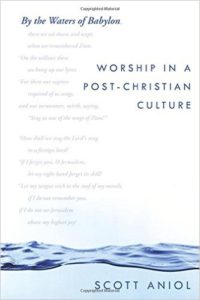 Scott Aniol’s new book, By the Waters of Babylon: Worship in a Post-Christian Culture, argues at length against the architects of missional evangelism—not because Aniol thinks the attractional model (of Hybels, Warren, et al.) is better, but because he doesn’t see cultural forms as neutral, suitable for any message including the gospel.
Here’s what I take to be his thesis paragraph for the book:
Although the missional church seems to correctly recognize the nature of the Christendom paradigm in western civilization and in many cases rightly discerns the integral relationship between Christianity and culture during that period, it appears to view this development in the history of the church as entirely negative, with very few positive fruits. At the very least, most missional advocates see what happened as merely neutral contextualization of the church’s worship to culture, yet their very quick dismissal of worship forms coming out of that period as simply antiquated “relics” reveals what may be a simplistic understanding of the impact of the church upon culture during that period. This perspective limits their ability to recognize the strengths of the cultural forms from that period in expressing Christian values and the vast differences that exist today with regard to culture and contextualization in worship.
“Haslam, who is a Christian, explained that not only would the bill violate the establishment clause of the First Amendment, but that it ‘trivializes the Bible, which I believe is a sacred text.’”
“He rightly notes that every generation in recorded human history sees the next as spoiled, lazy, and selfish. I agree. And every generation in church history tends to see the next as carnal, unorthodox, unevangelistic, and uncommitted. But it’s just not so.”