Body
- About
- Forum
- Account

Apparently some are all “shook up” over the practice of greeting visitors during worship services. A variety of polls suggests that most visitors are extremely uncomfortable with this practice. Studies also suggest that many faithful church attendees are also uncomfortable with the practice of greeting the familiar, as well as those who may be new, in the ebb and flow of a church service.
Granted, there is clearly no Scriptural command to include a one minute and twenty-seven second opportunity in the worship service for greeting those you know or don’t know. There are a few passages though that speak to a practice of greeting one another with the “right hand of fellowship” (Galatians 2:9) and in other cases an “agape kiss” (1 Peter 5:14). However, these passages seem to simply report what was done and are not included to give a clear imperative for universal and normative church practice (though it’s enough to convince me of the benefit).
When I was a child, I enjoyed reading Highlights Magazine, a publication for children; the magazine is still flourishing in 2012. One continuous feature of Highlights is a sketch with carefully concealed objects that blend into the picture. In today’s article, I encourage you to sleuth the hidden objects common to two Bible texts.
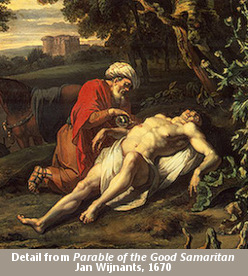
Most Christians are familiar with Jesus’ parable of the Good Samaritan found in Luke 10:30-35. Jesus was responding to the question, “Who is my neighbor?” by means of this story. Lois Tverberg, in her book, Walking in the Dust of Rabbi Jesus, suggests this parable is based upon a passage in 2 Chronicles 28. I agree.
You remember the essentials of the parable, don’t you? A Jewish man was going toward Jericho and was accosted by robbers who left him half dead. A priest and Levite (fellow Jews) passed by and ignored this man’s plight. A man from the despised Samaritan people, however, walked by and had compassion on the man. Luke 10:34-35 reads,
He [the Samaritan] went to him and bound up his wounds, pouring on oil and wine. Then he set him on his own animal and brought him to an inn and took care of him. And the next day he took out two denarii and gave them to the innkeeper, saying, “Take care of him, and whatever more you spend, I will repay you when I come back.” (ESV)
The tradition of the Good Samaritan, however, seems to originate in an obscure passage, 2 Chronicles 28:15. The soldiers of the Northern Kingdom of Israel—Samaria—had slaughtered 120,000 Judeans and captured another 200,000 as slaves. The prophet Obed spoke a word to the Lord shaming the Samaritan Jews and admonishing them to return the captive Judeans to their homeland. Surprisingly, the people responded. As we read the response, look for evidence suggesting that the Good Samaritan parable is a midrash (elaboration) upon these historical events. See how many similarities you can note.