Body
“How can a person who has betrayed trust, lied, broken promises, and deceived even their own loved ones come to share in the blessing of God? Hope begins for these brothers… when God awakens the conscience” - Colin Smith
“How can a person who has betrayed trust, lied, broken promises, and deceived even their own loved ones come to share in the blessing of God? Hope begins for these brothers… when God awakens the conscience” - Colin Smith
“Having said that, undue shame is a horrible thing…..Another kind of undue shame is that kind that hangs onto sins that have been truly confessed, repented of, and forgiven by Christ.” - Credo
“…. the Senate adopted the first two parts of the House version but dropped ‘nor shall the rights of conscience be infringed.’ After that, a direct protection of the individual right of conscience never reappeared in the language of the final religion clauses.” - TGC

Christian liberty can be a thorny issue. Some sincere Christians fail to recognize this category at all. They have an opinion about nearly everything and endeavor to impose their conclusions upon others, treating each issue as if it is a Christian duty. To fail to submit to their understanding is, in their minds, to sin. They have little regard for Christians who do not hold the same opinion as themselves.
“Your conscience, as Colin Smith has suggested, is like an alarm clock. It’s designed by God to go off at the right time. And just like an alarm clock, our conscience can go wrong in one of two ways.” - TGC
“Christian videographers will not be forced to produce videos of same-sex weddings.” - David French
“Paul didn’t command the stricter Christians of Romans 14 to get with the program and start eating meat as Jesus allowed. Nor did he command the meat-eaters to end their carnivorous ways on the outside chance they might upset the vegetarians.” IX Marks
In chapter 5, Naselli and Crowley discuss “Twelve Principles about How to Disagree with Other Christians on Disputable Matters.” #1 is “Welcome those who disagree with you (Rom. 14:1-2).” Here they re-define the weak conscience:
The goal of this book is “to put conscience back on your daily radar, to show from Scripture what God intended and did not intend [the] conscience to do, and to explain how your conscience works, how to care for it, and how not to damage it.”1
As their titles suggest, the first two chapters deal with defining the conscience. Chapter 1 defines the conscience as “your consciousness of what you believe is right and wrong.” Chapter 2 examines how the New Testament writers taught about conscience and develops a biblical understanding of the conscience from these data. Included in this is a definition of the “weak conscience”: an “uninformed moral consciousness.”2 As we’ll see later, this is the first of two definitions given in this book, and this presents a dilemma.
Chapter 3 answers, “What Should You Do When Your Conscience Condemns You?” The answer is the gospel, for nothing but the grace of God in the atoning work of Jesus can free us from guilt. This applies to the lost man approaching the cross with his guilt and the long-time believer who must again and again return to God in confession and seek forgiveness. We must never allow our guilt to become a tool for the accuser to bring us to despair.
(Read the series so far.)
We all seek to apply Scripture to our lives. Those applications should be both biblical and logical. We have seen1 that at least some applications ought to be thought of as particular to each believer. This means that sometimes, at least, my application, even if it is really biblical, logical, and God-intended, is still only my application, and might not be God-intended for my friend.
But are all applications particular, or are some universal? Are there “good and necessary” applications that we all must make? And if so, what impact do these have on the matter of applications that shape and train our consciences?
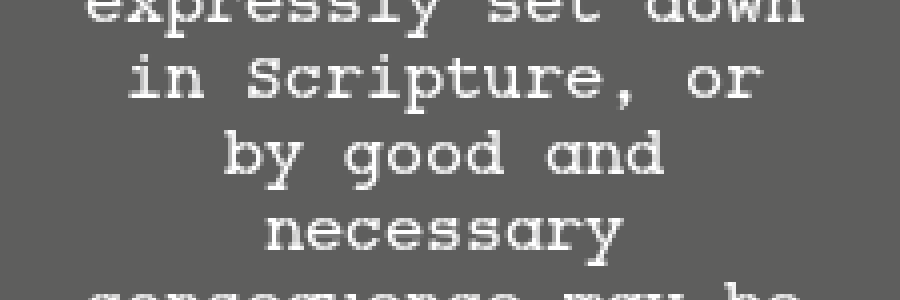
The phrase “good and necessary consequences” (hereafter, “GNC”) comes from the Westminster Confession of Faith2 (WCF):