SHARPER IRON
“As iron sharpens iron, so one person sharpens another.” (Proverbs 27:17)
  • About
    • About Sharper Iron
    • Doctrinal Statement
    • Contact
    • Search
  • Forum
    • Forum Home
    • Comment Guidelines
    • Search
  • Account
    • Log in
    • Register

Martin Luther

The Reformation at 500: Luther’s Stand at Worms

By Paul J. Scharf on Fri, 04/16/21

Read Part 1.

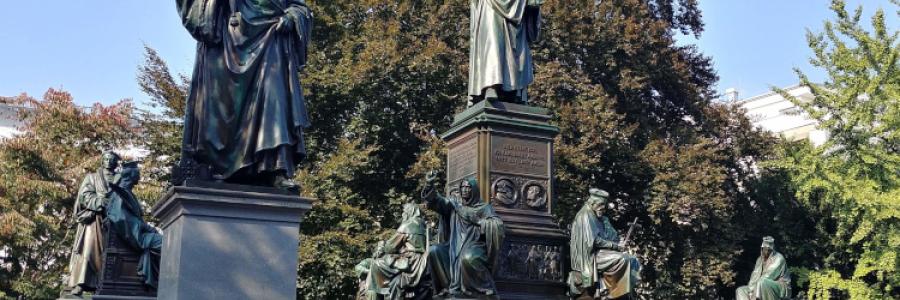
One of the most fascinating sights that we saw on our 500th-anniversary Reformation tour was the Luther Monument—sometimes called the Reformation Monument—which is located across the street from the park where Dr. Martin Luther’s famous stand before the Diet of Worms is memorialized.

The Reformation at 500: Luther’s Journey to Worms

By Paul J. Scharf on Fri, 04/09/21

It was a warm, sunny autumn Wednesday afternoon when our bus rolled into Worms, Germany—the second-to-last stop on the final day of touring on our 500th anniversary Reformation trip.

The town was decorated almost as if Luther himself were returning.

At the side of the road, we saw signs that read “Solus Christus,” “Sola Gratia,” “Sola Fide” and “Sola Scriptura”—like the placards that city residents might post to salute a winning sports team.

Martin Luther’s Death and Legacy

By Filings on Wed, 02/17/21
Body

“Just before he died [February 18, 1546], Luther preached what would be his last sermon from his deathbed in Eisleben. The ‘sermon’ consisted of simply quoting two texts, one from the Psalms and one from the Gospels. Luther cited Psalm 68:19, ‘Blessed be the Lord, who daily bears us up; God is our salvation.’ Then he cited John 3:16.” - Ligonier

Luther on Political Riots

By Filings on Fri, 01/08/21
Body

“Luther may have gone too far in urging the Princes to crush the Peasant Revolt by force, which they were sure to do anyway. But in doing so, he laid out some thoughtful principles about when legitimate protests go too far.” - Veith

3 Ways October 31, 1517 Affected Your Life Today

By Filings on Mon, 11/02/20
Body

“When Martin Luther pounded the 95 Theses on the door of Castle Church in Wittenberg, Germany, the effects rippled throughout space and time, changing the world then and there, as well as here and now, 503 years later.” - Cripplegate

The Reformation at 500: The Papal Bull (Part 2)

By Paul J. Scharf on Fri, 06/19/20

Read Part 1.

“Since God has given us the papacy,” Pope Leo X stated dramatically, “let us enjoy it.”

There was one man standing in the way of such enjoyment, however. Leo had little regard for the priest in Wittenberg, Dr. Martin Luther, who he referred to as “a drunken German.”

“He will feel different when he is sober,” concluded the pope.

His ability to underestimate Luther could not have been more profound.

The Reformation at 500: The Papal Bull (Part 1)

By Paul J. Scharf on Fri, 06/12/20

In September of 2017, my wife Lynnette and I were privileged to visit the land of Germany and tour the sites of the Reformation in celebration of its 500th anniversary.

The trip was memorable—even life-changing—for a number of reasons.

First of all, the trip was given to us by our friends at Grace Bible Church, in Portage, Wis., where I had served as interim pastor for nearly two years. Suffice it to say that we will never forget all that that congregation did for us.

Luther Meets Cardinal Cajetan

By TylerR on Mon, 06/08/20

This article originally ran in October 2017.

After Luther published his 95 theses, inviting debate on the abuse of indulgences, things began to move rapidly in Wittenberg. Phillip Schaff, the grand church historian, sums up the course of events during the following year:1

Is faith in politics “another Gospel”?

By Filings on Fri, 09/13/19
Body

“[T]o have a God is nothing else than to trust and believe Him from the [whole] heart,” Luther said. “That now, I say, upon which you set your heart and put your trust is properly your god.” - Acton (Gene Veith)

Theological Roots and Moral Fruits of Reformation

By TylerR on Tue, 12/05/17
Body

Place for Truth: Many agreed on the need for church reform, but Luther gave the reform theological roots … The cure is not that men do what they can, but that God does what men cannot. Hence salvation is by grace alone, through Christ alone, received by faith alone. That teaching led to Luther’s greatest moral reforms.

Pagination

  • First page
  • Previous page
  • Page 1
  • Page 2
  • Current page 3
  • Page 4
  • Page 5
  • Next page
  • Last page
Image
Image of file drawer

Footer

  • About
  • Contact
  • Search
  • Forum

Since 2005

Image
2005 SI Logo Image