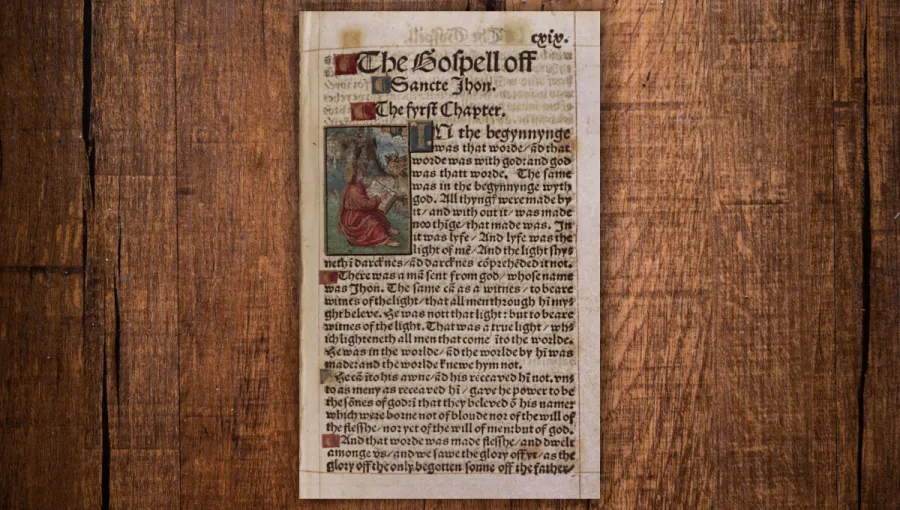
The first page of the Gospel of John: Tyndale New Testament (public domain)
Image
Read the series.
A turning point in the life of William Tyndale came in 1523 when he sought official church permission for his project of translating the New Testament from its original Greek into English. Cuthbert Tunstall, the bishop of London, brushed Tyndale’s request aside, setting his course for the final 13 years of his life. Tyndale would be a fugitive for more than a quarter of his short but eternally meaningful earthly existence.
He would soon leave for Germany, and it appears that he visited Martin Luther sometime after May of 1524.
John Foxe noted: “At his first departing out of the realm, Tyndale took his journey into the farther parts of Germany, and also into Saxony, where he had a conference with Luther and other learned men.”1
It is possible that Tyndale carried on his translation work there in Wittenberg, although it is completely unknown how long he stayed in the birthplace of the Reformation. Did he attend church with Luther? Did he take classes under him? Why did he decide to leave? These are questions with no answers this side of heaven. Oh what we might give to have recordings or transcripts of the conversations that unfolded while he was there!
It was, of course, during these pivotal years that Tyndale was completing his amazing translation project.
He first attempted the publication of an English New Testament at Cologne in 1525. But officials stormed his printer just as the gospel of Mark was coming off the press.
David Daniell writes about Tyndale and William Roye, whom he called “Tyndale’s assistant,”2 stating: “The Cologne authorities were about to arrest the two Englishmen and impound their work. Tyndale and Roye escaped and fled up the Rhine to Worms, taking their work with them.”3
Daniell describes how a man named John Dobneck—or Cochlaeus in Latin—was able to engineer this devious operation with the unwitting help of drunken “workers in the print shop” who had “boasted to him,”4 that “all England would in short time be Lutheran.”5
Having sailed to Worms under duress, Tyndale revised his first edition and prepared it for publication in 1526, basing his translation on Erasmus’ 1522 edition of the Greek New Testament. Copies were snuck into England by the thousands. As Peter Gurry states: “For the first time, the ordinary Englishman had a Bible he could understand—and afford.”6
Tunstall had a different reaction—burning Tyndale’s texts at St. Paul’s Cross in London, calling it “most pernicious poison.”7
Tyndale fled to Antwerp, Belgium, in 1528, and would mostly stay there until his death in 1536, except for some time in Holland.
It was there in Antwerp that the second edition of his text was published in 1534.
Throughout this time, Tyndale continued to face tremendous opposition from his homeland. It came in the form of voluminous writing against him by Sir Thomas More, and also through Cardinal Thomas Wolsley’s act of declaring him a heretic in 1529.
Yet, sadly, Tyndale’s most difficult days were still ahead of him. They would include shipwreck and the greatest betrayal of his life, along with a horrendous experience in prison and his final martyrdom.
We will pick up there and consider those matters in future installments.
John Foxe’s words again help us put these issues in perspective:
The books of William Tyndale having been published and sent over into England, it cannot be described what a door of light they opened to the eyes of the whole English nation. …
When these godly books of Tyndale, especially his translation of the New Testament, began to come into men’s hands, they wrought great profit to the godly. So the ungodly stirred themselves, envying and disdaining that the poor people should be any wiser than they; and again, fearing lest by the shining beams of truth, their false hypocrisy and works of darkness might be discerned. But especially Satan the prince of darkness, maligning the happy course and success of the gospel, set his might also to impeach and hinder the blessed labors of that man.8
Notes
1 John Foxe, The Acts and Monuments (1563). Family edition ed. M. Hobart Seymour (1855). Formatted, corrected, modernized with American spelling by William H. Gross, 23 April 2012. Last updated 16 February 2026. https://www.onthewing.org/user/Foxe%20-%20Acts%20and%20Monuments%20-%20…; Internet; accessed 14 October 2026, p. 1,203.
2 David Daniell, William Tyndale: A Biography (New Haven, CT: Yale University Press, 1994), p. 109.
3 Ibid.
4 Ibid.
5 E. Arber, English Reprints No. 28, Roye and Barlow: Rede Me And Be Not Wroth (London, 1871), pp, 20-24; and A.W. Pollard, Records of the English Bible (Oxford, 1911), pp. 99-110, as quoted in Daniell, p. 109.
6 Peter J. Gurry; “The Life and Legacy of William Tyndale.” Text & Canon Institute; 3 May 2022; https://textandcanon.org/the-life-and-legacy-of-william-tyndale/; Internet; accessed 15 October 2026.
7 Ibid.
8 Foxe, p. 1,203.
NKJV - Source
Scripture taken from the New King James Version®. Copyright © 1982 by Thomas Nelson. Used by permission. All rights reserved.
Paul Scharf 2023 bio
Paul J. Scharf (M.A., M.Div., Faith Baptist Theological Seminary) is a church ministries representative for The Friends of Israel Gospel Ministry, based in Wisconsin and serving in the Midwest. For more information on his ministry, visit sermonaudio.com/pscharf or foi.org/scharf, or email [email protected].