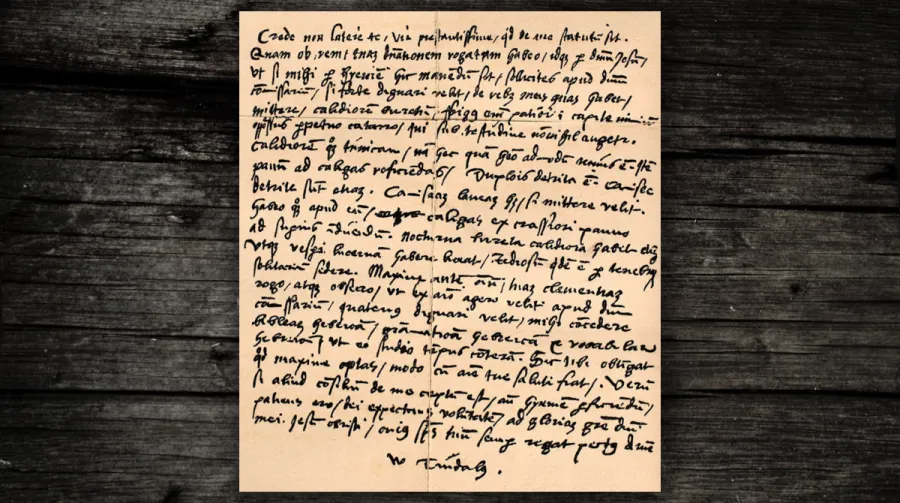
Photo of Tyndale’s prison letter, from William Tydale: A Biography, by R. Demaus, New Edition, revised by Richard Lovett (London, 1886), p. 437. (Bible Research)
Image
Read the series.
Be diligent to come to me quickly; for Demas has forsaken me, having loved this present world, and has departed for Thessalonica—Crescens for Galatia, Titus for Dalmatia. Only Luke is with me. Get Mark and bring him with you, for he is useful to me for ministry. And Tychicus I have sent to Ephesus. Bring the cloak that I left with Carpus at Troas when you come—and the books, especially the parchments. (2 Timothy 4:9-13)
Following his arrest on May 21, 1535, Master William Tyndale would never be free again. He was taken from Antwerp to a cell in the Castle of Vilvoorde, roughly six miles outside of Belgium. Brian H. Edwards paints a bleak picture of his existence there:
The castle of Vilvoorde had been erected in 1374 by one of the dukes of Brabant, and since it was modeled upon the infamous Bastille, built in Paris at about the same time, its moat, seven towers, three drawbridges and massive walls made it an impregnable prison. …Tyndale was thrown into one of the foul-smelling, damp dungeons with nothing for company but the lapping moat, the squabbling moorhens outside, and the dripping walls and scurrying rats inside.
Here, in his solitary darkness, Tyndale waited for the end.1
There he would remain for more than 16 months. Like the Apostle Paul in his final Roman imprisonment before facing martyrdom in 67 A.D., Tyndale wrote a letter from his prison cell. Paul’s final correspondence is recorded in the book of 2 Timothy—particularly chapter four. Tyndale’s document is the only one of this kind that remains from him. Originally written in Latin, it is strangely reminiscent of Paul’s last communication, even using a number of the same words and concepts.
Perhaps Tyndale was sending a signal to the generations that would follow, demonstrating his likeminded unity with the apostle. Or, maybe more likely, his mind was so “singularly addicted” to “the knowledge of the Scriptures”2 that the words of the New Testament, for which he would give his life, simply flowed through his mind to his pen.
While Paul composed his letter in Greek, Tyndale wrote in Latin. What follows is the English translation of that complete letter, as done by Jacob Isidor Mombert in 1884:
I believe, most excellent Sir, that you are not unacquainted with the decision reached concerning me. On which account, I beseech your lordship, even by the Lord Jesus, that if I am to pass the winter here, to urge upon the lord commissary, if he will deign, to send me from my goods in his keeping a warmer cap, for I suffer greatly from cold in the head, being troubled with a continual catarrh, which is aggravated in this prison vault. A warmer coat also, for that which I have is very thin. Also cloth for repairing my leggings. My overcoat is worn out; the shirts also are worn out. He has a woolen shirt of mine, if he will please send it. I have also with him leggings of heavier cloth for overwear. He likewise has warmer nightcaps: I also ask for leave to use a lamp in the evening, for it is tiresome to sit alone in the dark.
Like Paul (see 2 Tim. 2:21), Tyndale was understandably distraught about the onset of cold winter weather. How we can also lament with him when we read his haunting words about the darkness of the castle. Imagining the combination of these two is enough to make one weep. Tyndale then continued:
But above all, I beg and entreat your clemency earnestly to intercede with the lord commissary, that he would deign to allow me the use of my Hebrew Bible, Hebrew Grammar, and Hebrew Lexicon, and that I might employ my time with that study. Thus likewise may you obtain what you most desire, saving that it further the salvation of your soul. But if, before the end of winter, a different decision be reached concerning me, I shall be patient, and submit to the will of God to the glory of the grace of Jesus Christ my Lord, whose spirit may ever direct your heart. Amen.3
Just as Paul requested that his “papyrus scrolls” and “vellum sheets”4 be brought to him in Rome, so Tyndale’s greatest desire was for his Hebrew study tools.
Think of it—sitting in a wet dungeon cell surrounded by rats, Tyndale’s highest priority was to work on his translation of the Hebrew Scriptures. He must have possessed an almost unhuman amount of discipline, and certainly had a transcendent love of God’s Holy Word. Alas, as Edwards, notes wistfully, “His work that remained undone could never be completed.”5
According to Peter Gurry, “During his year in prison, Tyndale was interrogated by the local Catholic theological experts, the goal being to solicit a confession to save his soul from hell.”6
But John Foxe recorded the following, showing what Tyndale’s amazing zeal accomplished even during those darkest of days:
Such was the power of his doctrine, and the sincerity of his life, that during the time of his imprisonment, (which endured a year and a half), it is said, he converted his keeper, the keeper’s daughter, and others of his household.7
If Tyndale had never written a word that endured in the text of our English Bibles, his testimony and example would still make his life worthy of our study and emulation. Yet, think of it, this is the man who literally gave us the words of the New Testament in our native tongue! What can we even begin to say about such an incredible legacy, except to offer our own testimony of thanksgiving.
There is one more, exceedingly sad—and yet gloriously triumphant—chapter in Tyndale’s life. We will take that episode up in our next installment.
Notes
1 Brian H. Edwards; “Tyndale’s Betrayal and Death.” Christian History Institute; n.d.; https://christianhistoryinstitute.org/magazine/article/tyndales-betraya…; Internet; accessed 11 November 2026.
2 John Foxe, The Acts and Monuments (1563). Family edition ed. M. Hobart Seymour (1855). Formatted, corrected, modernized with American spelling by William H. Gross, 23 April 2012. Last updated 16 February 2026. https://www.onthewing.org/user/Foxe%20-%20Acts%20and%20Monuments%20-%20…; Internet; accessed 11 November 2026, p. 1,200.
3 Jacob Isidor Mombert, William Tyndale’s Five Books of Moses Called the Pentateuch: Being a Verbatim Reprint of the Edition of M.CCCCC.XXX. (New York and London, 1884), pp. li-lii. Quoted as “Tyndale’s Letter from Prison.” Bible Research; n.d.; https://www.bible-researcher.com/tyndale3.html; Internet; accessed 11 November 2026.
4 John MacArthur, gen. ed., The MacArthur Study Bible, 2nd Edition, ESV (Nashville, TN: Thomas Nelson, 2021), p.1,724, note on 2 Tim. 4:13.
5 Edwards; “Tyndale’s Betrayal and Death.”
6 Peter J. Gurry; “The Life and Legacy of William Tyndale.” Text & Canon Institute; 3 May 2022; https://textandcanon.org/the-life-and-legacy-of-william-tyndale/; Internet; accessed 11 November 2026.
7 Foxe, V, pp. 127. As recorded in David Daniell, William Tyndale: A Biography (New Haven, CT: Yale University Press, 1994), p. 381.
NKJV - Source
Scripture taken from the New King James Version®. Copyright © 1982 by Thomas Nelson. Used by permission. All rights reserved.
Paul Scharf 2023 bio
Paul J. Scharf (M.A., M.Div., Faith Baptist Theological Seminary) is a church ministries representative for The Friends of Israel Gospel Ministry, based in Wisconsin and serving in the Midwest. For more information on his ministry, visit sermonaudio.com/pscharf or foi.org/scharf, or email [email protected].